What Complexity is Often Hiding
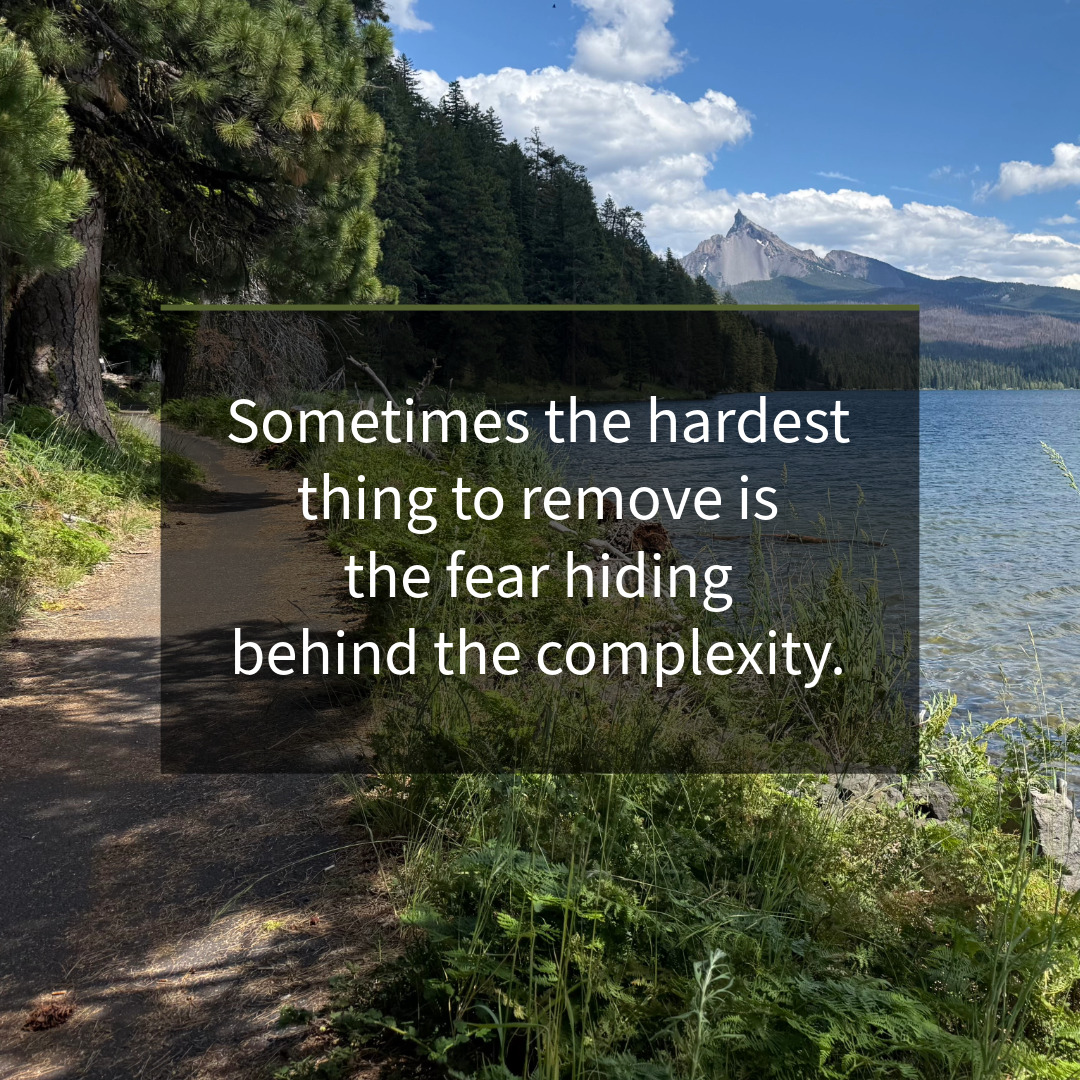
I met Ken at a Chamber of Commerce Greeters meeting.
If you’ve never been to one, here’s how it works. A room full of business owners and representatives, and everyone gets about a minute to tell you what they do. It’s fast. It’s loud. And most people use their sixty seconds the same way: name, company, what they sell, call to action.
Not Ken.
Ken was an IT guy. Solo operation. He may have had twenty years on me, and there was a gentleness about him that you don’t always find in a room full of people trying to make an impression. When it was his turn, he didn’t pitch. He shared a quote.
“Perfection is achieved, not when there is nothing more to add, but when there is nothing left to take away.” Antoine de Saint-Exupéry.
That was his business philosophy. His tagline. His north star.
In a room full of people telling you what they could add to your life, he stood up and talked about subtraction. I introduced myself to Ken after the meeting. We talked at several Greeters meetings after that. More than smart, which he was, he had great wisdom. He would never have told you that. He was meek in the truest sense. Not weak. Meek. Strength under control.
I didn’t have language for it then, but something Ken said that day started shaping how I thought about leadership. It just took me a while to realize it.
A while back, I came across this from Shane Parrish:
“Complexity increases because adding is easy and removing is dangerous. Whenever there’s a problem, we add: a new person, requirement, or process. We never subtract. Why? Because everything that already exists has a champion. That clause in the tax code, that step in the process, that feature in the product… someone fought for it, and they’ll fight you if you try to remove it. So we become professional complexity managers. Entire careers are built managing unnecessary mass. But this is the opportunity. While everyone else adds mass to the system, removing it creates an unfair advantage. The lighter you are, the faster you move. Removing what shouldn’t exist creates more value than any addition could.”
I held onto that one. Sat with it. Reflected on it personally.
Then a bunch of unrelated but similar situations started piling up around me, and the Parrish quote came back to mind. I finally shared it with our leadership team.
It resonated. One of our leaders replied: “On my team, many of our processes started with good intent, but over time they can add complexity and sometimes without clear value. This is a great reminder to regularly ask whether something is still serving its purpose or simply adding weight… Framing removal as refinement, rather than loss, also feels key to making this work sustainable.”
She’s right. And she put words to something I’ve watched play out in almost every organization I’ve been a part of.
I’ve been in organizations where the complexity was real and suffocating. Every decision required a sign-off. Every sign-off needed a sign-off.
Good people spent enormous energy managing the system instead of doing the work. The intent was accountability. The result was paralysis.
I’ve also seen organizations that wore their lack of complexity like a badge of honor. No bureaucracy. No red tape. Move fast. Which sounds great. Until it doesn’t. Because somewhere between “we trust people to figure it out” and “why isn’t anyone on the same page,” something got lost: clarity. The absence of structure became its own kind of confusion.
Too much. Too little. Both produce a result that’s less than it could have been.
So where does all this unnecessary complexity come from?
Let me tell you my story. And then I’ll ask you about yours.
My version showed up as the “check-in” (if I’m being honest with myself, I already know what my team calls it when I do it). I told myself I was being supportive. Being available. What I was really doing was managing my own uncertainty about whether I had communicated well enough on the front end. And rather than go back and fix the communication, I added oversight. I added presence. I added complexity.
It wasn’t really about them. It was about me. A lack of confidence in whether I’d set them up well. A lack of confidence in myself as a leader. I was afraid they wouldn’t deliver what I needed, which, if I’m honest, was really a fear that I hadn’t given them what they needed to succeed.
Fear, dressed up as leadership.
And it shows up in more ways than one.
What this might look like for you:
You tell yourself you’re “staying looped in.” What you’re actually doing is managing your anxiety about whether the work will reflect well on you.
You add a process instead of having a conversation. A new form. A new approval step. A new check-in cadence. Because it’s easier than addressing the actual problem directly with the actual person.
You send the “just checking on the status” message. Twice. On something that hasn’t had time to move.
You copy everyone on the email. Not because they need to know. Because you want cover.
You send a “friendly reminder” email to the whole team instead of talking to the single person the message was actually meant for.
You give people just enough information to complete the task, but not enough to make decisions. Which keeps you the necessary person in the chain.
You escalate to your boss before you’ve tried to resolve it yourself. Because if it goes sideways, at least it won’t be only your fault.
The better version of me has learned, and is still learning, to do the harder work earlier.
Communicate before the project starts, not after it stalls. Describe the What clearly. Explain the Why honestly. Then let them figure out the How. Stay available without hovering. Trust the people you hired.
One of the people on my team has earned the confidence and has my full permission (even my request) to look at me and ask: “Why are you in my weeds?” It makes me laugh every time. And I appreciate it every time. Because she’s usually right.
That’s not a framework. It’s a decision you make, usually when it’s uncomfortable, to lead on the front end instead of managing from behind.
Ken figured this out. He built his whole business around the discipline of removing what didn’t need to be there. I’m still trying to apply the same idea to teams, and I’ll tell you it’s harder than it sounds. Because adding feels like helping…like adding value.
But Parrish is right. The lighter you are, the faster you move.
Your Turn
A few honest questions worth sitting with:
- What process, approval step, or check-in cadence are you maintaining right now that exists more for your comfort than for your team’s effectiveness?
- What would you have to trust, or let go of, to lead with more clarity and fewer check-ins?
- Is there someone on your team who would feel safe enough to tell you when you’re in their weeds if you encouraged it?
- What would it look like to remove one thing this week, not add one thing?
One More Thing
I want to say it carefully.
If you’re reading this and thinking less about yourself and more about someone above you, someone whose version of fear looks like the list above, I see you. That experience is real.
Here are three things that might help right now:
Name It. Name what you’re experiencing without dramatizing it. “My leader tends to over-communicate when they’re uncertain” is more useful than a story about being micromanaged. Clarity about the pattern helps you respond to it rather than just react to it.
Ask the Question. Create clarity where your leader hasn’t. If the expectations weren’t clear on the front end, ask for them directly. “Can you help me understand what a win looks like here?” is a question that benefits everyone, including the leader who forgot to answer it first.
Don’t Carry It. Don’t absorb their anxiety as your own. Their need to check in is often about them. Do good work. Document it. And don’t let someone else’s uncertainty become your identity.
Be Encouraged.
Leave a Reply