Sharing things that resonate, influence, and encourage
Author: Tim Pritchett
Sharing things that will resonate, influence and encourage people one post, person, or picture at a time. Share your favorite encouraging and inspirational quote.
|Hope| Hope transforms every trial. |Kris Langham|
You’ve probably seen the post or the sweatshirt that says, “Everyone is fighting a battle you know nothing about. Be Kind.” I like that. It creates space for grace and empathy. However, it’s lacking… it’s the silence at the end that is deafening – especially if you’re the one fighting the battle.
If the statement ends there, there is someone just going through it, doing their best – sometimes just fighting to keep their head above water. Maybe it’s you? You’re fighting the battle. Doing your best, but it’s taking its toll. It’s causing you to be less patient than usual. Your short response brings a retaliatory reaction from the barista, the guy driving slow in the fast lane, “…if they only knew what I was going through…”
What if they did know what you’re going through? What would you want from them? Help? Sure. We’ve all had that friend, family member, and sometimes even a stranger who steps in to offer a helping hand to help lift the load, watch the kids, or run interference for you. It’s great, but likely, something more got you to that point that is still unresolved. Maybe that helping hand was just enough help for you to get your feet under you and keep going. Excellent. But often, there is still an ache, a gap that needs to be filled.
Hope is often the real missing ingredient. The storm is raging. The night is dark, “… here’s an umbrella…” Thanks – but the storm is still there, and the night is still dark. But instead of an umbrella, what if there was the promise of warm shelter just around the bend, and there is a trustworthy guide to lead you there? Hope. Suddenly, you muster the strength to dig deep and take the final steps to get you to the sanctuary. The storm is still there. The night is still as dark, but suddenly, there is hope.
Trials seem to come at a constant rate. I have them. The people in the circles around me have them. A friend remembers his wife passing from cancer 10 years ago. A buddy wrestles with the weight and evil he sees daily as a detective. Another is looking for work.
My word for you…for them…for me: Hope. It’s there – I promise. If you’re having a hard time finding it, ask that friend or family member to help you find it. It’s there. Perhaps you’re in a place where you can be the one to offer hope. You can be the guide who knows about the shelter.
There is hope. Set your mind to find it.
Offer hope. Be intentional about sharing it with those around you.
When the storm calms, and it will… When the dawn breaks through, and it will… be grateful. Gratitude is good for the soul.
|Slow| Slowing down reminds you that the journey is supposed to be fun. | Anne Bancroft|
The New Year often ushers in new year resolutions, new deadlines, new to-do lists, and new commitments. These aren’t necessarily bad, but they can distract us from what truly matters.
The turn of the calendar is a chance to slow down – a reminder that life is a journey to be savored, not just a series of boxes to be checked. In a culture of “rise and grind,” finding joy, choosing rest, and being still can be met with resistance (both internal and external) and criticism (both internal and external). But that act of slowing down… that decision to be intentional about rest are key ingredients to peace and joy.
Maybe you ended 2024 thinking that 2025 would start off differently (“…it certainly can’t get any worse…”), but hours, days, or weeks into the “new” year, it all seems like it’s more of the same – or, yes, even worse. This is why the reminder to slow down is so important. Slowing down lets you consider and focus on what matters – a coffee with a friend, enjoying deep laughter, or lounging on a quiet evening. It can also include finding the good in the hard or finding freedom in routine. Discovering that you’re stronger than you thought and more resilient than you previously believed.
Please rest. Please take care of yourself. Please slow down. But also, please know there is joy in the journey – even if things aren’t going as you’d hoped in this season. Look for the good. Focus on gratitude, even in the smallest things. And as always…
When “leadership” is mentioned, many ideas can come to mind. Vision. Decisiveness. Strength. Strategic. Competitive. All of these may be accurate. Many are desirable, but some, depending on how they are portrayed, may not.
Two ideas have influenced my perspective on leadership. The first came from my business coach, who said, “The accumulation of little things is often more impactful than the one ‘big thing.'” The second is a succinct quote from John Maxwell: “Leadership is Influence.” These quotes added nuance to my experiences with the leaders in my life—both good and not-so-good. They have also led me to the ideology and approach to leadership called Servant Leadership.
Servant Leadership
Robert K. Greenleaf formalized the idea of Servant Leadership in a series of essays. The term Servant Leader was introduced in an essay called The Servant as Leader, published in 1970. From the first time I read about it, the approach of Servant Leadership resonated with me. It aligned with my values and my view of people.
Greenleaf’s ideas were, in part, inspired by Hermann Hesse’s novel The Journey to the East (1957). In Hesse’s story, the character Leo embodies servant leadership. He starts as a servant to a group of travelers. (Warning: Spoiler Alert!) Later, it’s revealed that Leo is the spiritual leader of a secretive group called the League. The parable teaches that leadership isn’t about title or role; it’s about serving and uplifting others.
Applying Servant Leadership.
In his essay, Greenleaf has a line that resonates with me and, in my opinion, is the litmus test of being a leader:
Do those served grow as persons? Do they become healthier, wiser, freer, more autonomous, and more likely themselves to become servants?
My influence… my leadership, can be revealed in those around me. I care, support, serve, and influence them. I often miss the mark, but this is what I aspire to.
The Traits of a Servant Leadership
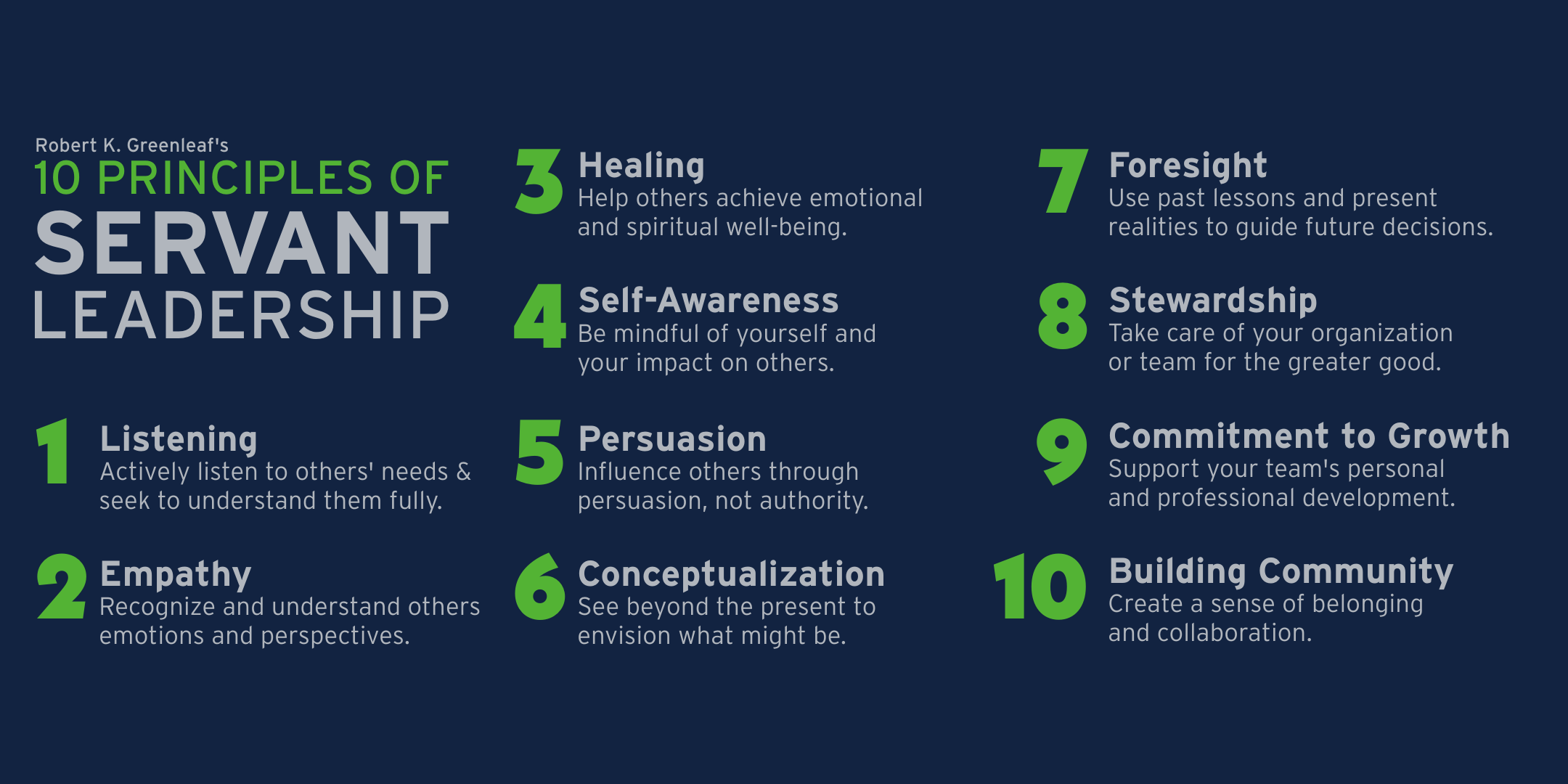
Greenleaf outlined ten traits of servant leaders:
Listening: Actively listen to others’ needs and seek to understand them fully. Often, this requires that we listen more than we talk. Consider more than we persuade. This leads nicely to the next trait…
Empathy: Recognize and understand others’ emotions and perspectives. Alfred Adler described empathy as “Seeing with the eyes of another, listening with the ears of another, and feeling with the heart of another.”
Healing: Help others achieve emotional and spiritual wellbeing. This idea might lead you to the thought, “… but that’s…*EMOTIONAL*… this is work! Can’t we just avoid emotions and do work…” I’ll let you decide if those things can be separated.
Self-Awareness: Be mindful of yourself and your impact on others.
Persuasion: Influence through persuasion, not authority.
Conceptualization: See beyond the present to envision what might be. Another way to think of this is “looking forward.”
Foresight: Use past lessons and present realities to guide future decisions. Another way to think of this is “looking back.”
Stewardship: Take care of the organization or the team for the greater good.
Commitment to the Growth of People: Support your Organization’s/Team’s personal and professional development.
Building Community: Create a sense of belonging and collaboration. We were made for community.
I’ve seen and read an additional trait that other students of servant leadership have added:
Bonus: Calling: You are the right person, at the right time, for the right reason. You may not feel like a “leader” or even want to be one. But for whatever reason, you are in the position you are, with the influence you have for a reason. Embrace it.
Leadership is not always “the one big thing.” Very often, it presents itself in the collection of small things done well and consistently.
“Every action you take is a vote for the type of person you wish to become. No single instance will transform your beliefs, but as the votes build up, so does the evidence of your new identity.”
This applies to becoming the leader you want to be and that those around you want you to be.
Myths of Servant Leadership
As I’ve studied servant leadership, I have seen opponents to the idea because it’s so contrary to “traditional leadership.” A few examples include:
Servant Leadership is just “easy” or “being everyone’s friend.” I can appreciate the thought process to get there when I hear this, but I disagree with the conclusion. A quote I recently read provided a great response. In his book Know What Matters, Ron Shaich says,
“Servant leadership isn’t about being nice at all costs. It’s about being helpful at all costs. And radical honesty is a much greater service to people than simply being kind.”
Servant Leadership is just a “Christian/religious thing.” Without a doubt, there is a spiritual quality to servant leadership. Many people will point to Jesus’s quote, “Jesus called them together and said, “You know that the rulers of the Gentiles lord it over them, and their high officials exercise authority over them. Not so with you. Instead, whoever wants to become great among you must be your servant, and whoever wants to be first must be your slave— just as the Son of Man did not come to be served, but to serve, and to give his life as a ransom for many.” Matthew 20:25-28
Servant Leadership is seen in quotes from teachers of many faiths:
Mahatma Gandhi: “The best way to find yourself is to lose yourself in the service of others.”
Dalai Lama: “Our prime purpose in this life is to help others. And if you can’t help them, at least don’t hurt them.”
Thich Nhat Hanh: “The practice of compassion and loving-kindness is not about being nice but about being real and truthful, helping others to transform their suffering.”
Prophet Muhammad: “The leader of a people is their servant.”
Guru Nanak: “The essence of life is to serve others and do good.”
Servant Leadership Sacrifices Results for Relationships: Simply because you focus on people and their well-being and growth doesn’t mean you ignore outcomes. My experience is that when you focus on people, you have better outcomes, able to stand to adversity and challenges, and can do it faster (Ref. Steven Covey, The Speed of Trust)
I found this list and these traits interesting compared to the material I was preparing. When servant leadership is demonstrated well, people are drawn in and thrive.
Your Influence Matters
I believe we’re all here for a reason. I believe you’re in the situation you’re in—good or bad, challenging or encouraging—for a reason. You have the opportunity to learn. You have the opportunity to serve. It’s about choosing to do the small things that build trust, inspire others, encourage others, and foster gratitude in others and yourself. By focusing on the well-being and development of others, we can make a lasting impact—not just as leaders but as human beings. One last quote to drive this point home, Donald McGannon says,
Leadership is an action, not a position.
Lead with intention, serve with humility, and influence with purpose.
Be Encouraged. Be an Encourager.
If you’re interested, here is a version of the slide deck I’ve used to present the ideas of servant leadership. Servant Leadership Slide Deck
Servant Leadership Traits – Desktop Reminder. I have this sitting on my desk at all times.
He is a wise man who does not grieve for the things which he has not, but rejoices for those which he has. |Epictetus|
Christmas is in just a few days. Recently, in an all-company meeting, I began discussing many of our team’s activities that give back to our community and some of the real needs that exist. I mentioned that one of the critical clothing needs the Hearts With a Mission Youth Shelter has is packages of new underwear or socks. Underwear. Socks.
We were reminded and shared how much we have to be thankful for. As we talked about gratitude, I was overwhelmed—nearly brought to tears. We’re so blessed. You may have hardships and difficulties. I don’t make light of that. But if you’re reading this, you’re blessed. You have access to electricity and a computer, probably somewhere inside… We have much to be thankful for.
But the temptation to chase more – more gifts, more decorations, more perfection, more…more. But in this season, we have the opportunity to pause and embrace gratitude. I’ve heard it asked, what if you woke up tomorrow only with what you were thankful for today?
There are hardships, for sure, but please don’t fall into the trap of focusing on what you don’t have. Instead, celebrate what is already good in your life. Please meditate on and be grateful for the love of family and friends…the peace that can be found in quiet moments, the help and support of those around you. The ability to offer help and support to those around you. When our thoughts and perspectives are guided by gratitude, even the smallest things become great treasures.
This Christmas, put aside the focus on what you’re missing and choose to rejoice in what you have. Gratitude transforms what we have into enough.
Away in a manger No crib for a bed The little Lord Jesus Laid down His sweet head
Bless all the dear children In Your tender care And fit us for heaven To live with You there
There are a lot of articles, videos, and books about Objectives and Key Results (OKRs). Here’s how I talk about OKRs.
OKRs are a tool to help with organizational alignment to focus on what is most important to accomplish in the next three, six, or 12 months. OKRs were popularized by tech companies like Google. As discussed in his book High Output Management, the concept’s genesis came from Andy Groves at Intel. The modern iteration of the idea is discussed in the book Measure What Matters by John Doerr. According to the book, Doerr is the one who introduced the concept to Larry Page and Sergey Brin in the early days of Google.
What are OKRs?
OKRs consist of two main variables:
Objects: These are aspirational and qualitative goals describing WHAT you want to achieve.
Key Results: These quantifiable metrics measure progress and create visibility. They are specific, time-bound, and measurable. To ensure they are on point, the phrase “as measured by” can often be included with Key Results.
Objective: Improve customer satisfaction and loyalty.
Key Results:
Resolve 95% of customer issues within 24 hours by the end of 1st Quarter.
Increase Net Promoter Score (NPS) from 70 to 85 by the end of the 2nd Quarter.
Conduct customer satisfaction surveys after each interaction and achieve a 4.5/5 average rating across all product lines by the end of the 2nd Quarter.
OKR Superpowers
In Measure What Matters, Doerr describes four Superpowers of OKRs
Focus and Commit to Priorities
Align and Connect for Teamwork
Track and Accountability
Stretch for Amazing
OKRs For-profit and Nonprofit Organizations
While the OKR framework can work across all landscapes, the implementation and focus can differ between For-Profit and Nonprofit organizations.
Similarities
Clarity: Regardless of the type of organization you are in, OKRs bring to what is important and create alignment across teams.
Results: OKRs track measurable outcomes and focus on the results.
Agility: Based on the reporting and results, OKRs can quickly adjust to reflect changes in the landscape.
Difference
Focus: For-profits often focus on revenue, customer satisfaction, or process improvement. In contrast, nonprofit OKRs are frequently mission-centric, prioritizing community impact, fundraising, or volunteer engagement.
Beneficiaries: Nonprofits align more towards donor expectations and program participants, whereas a for-profit aligns towards shareholder value.
Resources: Nonprofits frequently face challenges and constraints in funding and staffing. This can require some creative problem-solving to set realistic key results.
Steps to Implement OKRs
Understand the Purpose of OKRs
Help others understand that OKRs are a tool for setting and tracking goals, driving focus, alignment, and engagement within the organization.
Ensure that your leadership team and employees understand the value and purpose of OKRs.
Often, OKRs are a new idea, so the “Why” is as important (if not more so) than the “What” or the “How”.
Define the Objective
Identify a high-level, qualitative goal that highlights an area of improvement or strategic priority for the organization.
Make sure the objective is aspirational and clear.
Align Team and Individual Objectives
The organizational objective will cascade down and inform the team objectives, which will cascade down and inform the individual objectives. If they don’t, you’ll have a misalignment, confusion (probably frustration and lack of engagement), and, likely, miss achieving your objective.
Set Measurable Key Results
I have found the most success in using 2-4 Key Results. Some will argue for more, but the value of OKRs is to create focus. “If everything is important, nothing is important.”
Make sure the Key Results are specific, time-bound, and challenging yet achievable. Including the team in creating the OKRs often provides a better outcome.
Communicate the OKRs
I’m an advocate for having as much of the organization/team as possible involved in creating the OKR for greater buy-in from the start. Regardless, once the OKRs are created, transparency and communication are essential. A kickoff meeting or presentation can be valuable.
One organization I worked on OKRs with, each team completed their OKR launch with a skit describing their objective and key results. It was fun and informative.
Track and Report on Progress Regularly
DON’T Overcomplicate this. A simple solution is better than no solution. There are a lot of tools and software platforms out there. While helpful, a simple spreadsheet can get the job done as effectively.
The important thing is to have a regular cadence (weekly, biweekly, or monthly) to report on progress, address roadblocks, and adjust as needed.
Evaluate and Reflect
The person who first introduced me to OKRs would often say, “Win or Lose, watch the tape.” Take time with your team to review the results, discuss successes, and identify areas for improvement.
Remember “Stretch for Amazing” – even if you didn’t achieve 100% of your goal, how much improvement and/or growth has been realized? Celebrate!
Iterate and Improve
Use what you’ve learned from this round of OKRs to help inform and improve your next OKR cycle. OKRs are living tools – not a “set ’em and forget ’em” approach.
You’re always looking for ways to improve over what you did last time. As you grow and strengthen your OKR proficiency, you’re set up to make more impactful and meaningful OKRs for your organization.
Some Common Mistakes
I’ve led a lot of conversations and OKR implementations. I have had and seen great success. I’ve also made a lot of mistakes. Here are a few things to consider and avoid:
Don’t Set Too Many Objectives: Focus. Focus on a few priorities to avoid spreading you, your team, your organizations, or your resources too thin.
Be Specific: Vague Key Results can sometimes sound great, but in the end, you realize you didn’t really know what you were aiming at. Keep Key results specific and measurable to track progress. Remember: “…as measured by…”
Get Buy-In Early, Often, and Throughout: Engage your team in the process and make sure everyone is bought and supports the idea. As a solo crusade, this can be a heavy rock to push if you’re the only one.
Align to Culture: Culture is a big deal for me. Your OKRs have to align with who you are as an organization. Don’t just copy/paste an OKR you found online. What does your organization need? How do you think/talk/solve that need?
Reporting on Progress: Drive on this until it’s an automatic habit. Regularly review and update on the progress of your OKRs to maintain momentum. In the midst of a problem or setback is the time to discuss it and solve it – not after.
OKRs are a proven methodology for:
Achieving focus and clarity
Creating alignment within the organization, teams, and locations
Provide visibility and transparency on progress, problems, and successes
Encourage a growth mindset and stretch your team and organization to achieve great things
OKRs can help you translate your vision into actionable steps. Start small, learn and adjust, and watch your organization grow.
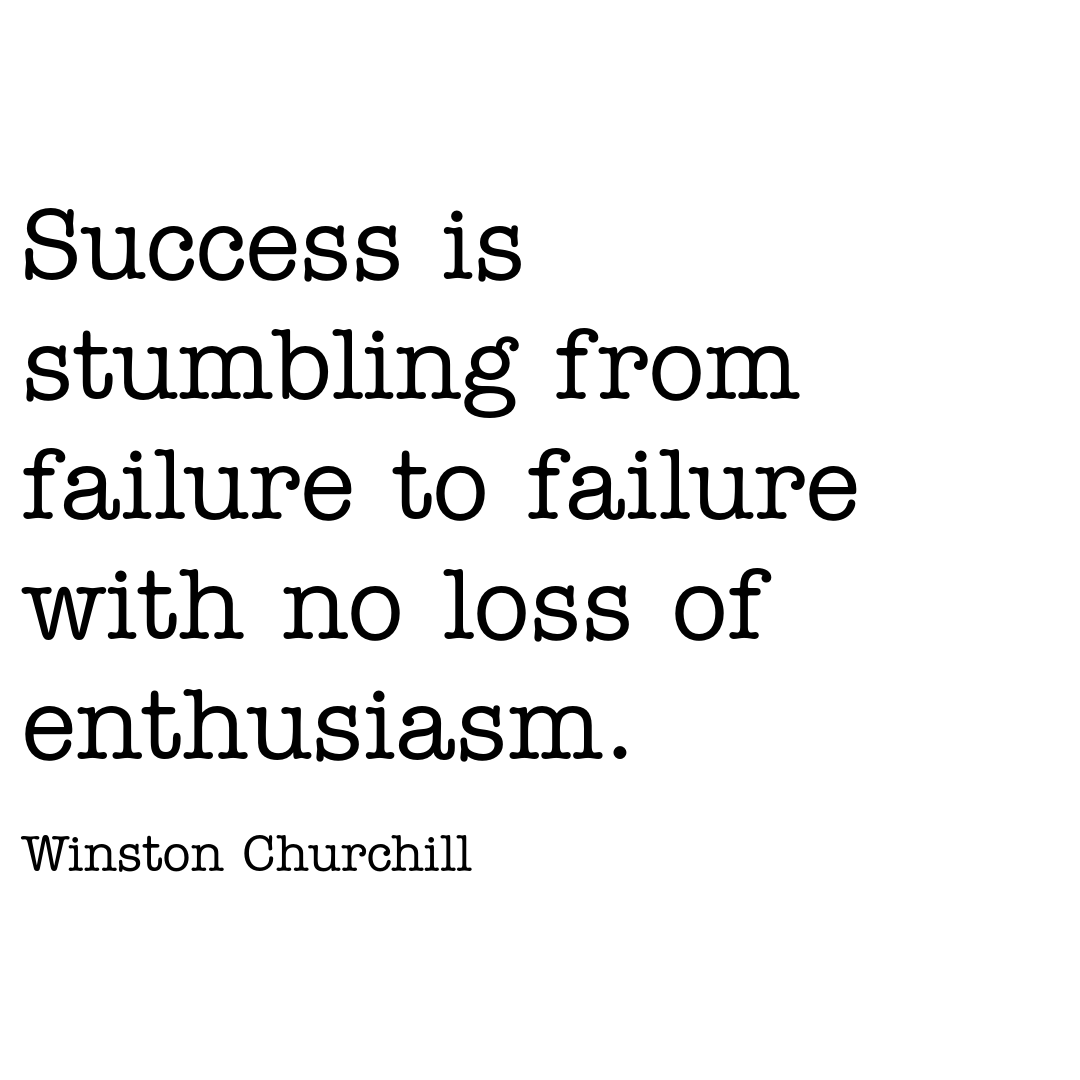
|Success| Success is stumbling from failure to failure with no loss of enthusiasm. Winston Churchill
Success often comes through perseverance, not perfection. Embrace each setback as a stepping stone, maintaining enthusiasm despite the stumbles. Every failure is a lesson, an opportunity to grow and refine your approach. Keep your spirit high and your vision clear, understanding that persistence is the key that unlocks the door to success. Celebrate your resilience and determination, as these qualities will carry you forward.
Stay passionate and positive, understanding that each step, even the difficult ones, brings you closer to your goals. By embracing the process with a joyful heart of gratitude, you pave the way for true success and inspire others to do the same.
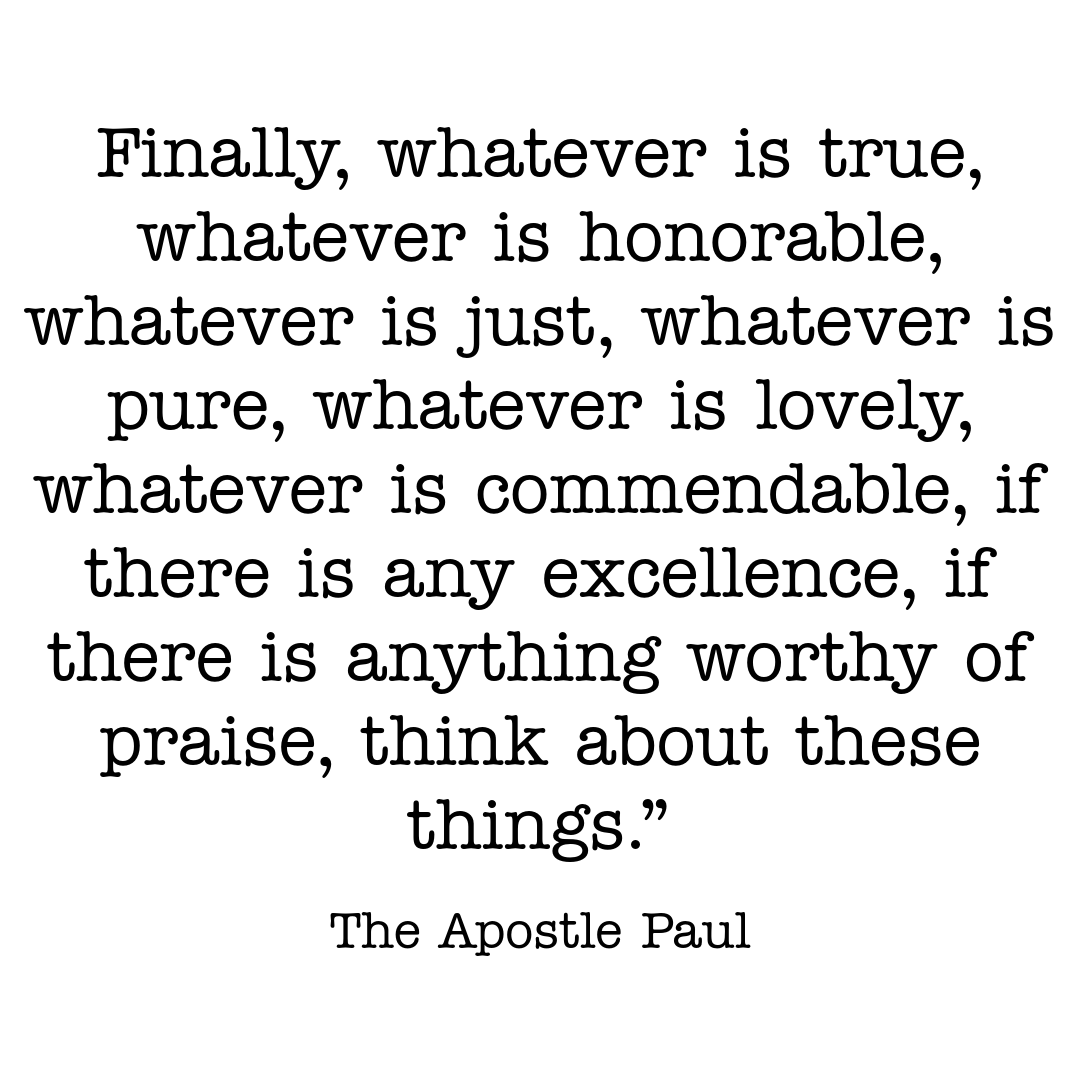
|Think On These Things| Whatever is true, whatever is honorable, whatever is just, whatever is pure, whatever is lovely, whatever is commendable, if there is any excellence, if there is anything worthy of praise, think about these things. The Apostle Paul
In a world filled with challenges, be intentional and focus on what fills your soul. Embrace truth and honor in your thoughts. Seek justice and purity in your actions. Appreciate the beauty and magnificence around you, finding peace in the small moments and feeling uplifted by the joy they bring. When you focus on what is praise-worthy, you cultivate a positive and resilient mindset. This practice not only makes your life better but also spreads faith, hope, and love to those around you.
Let your thoughts be a sanctuary of goodness and peace, guiding your actions and shaping a brighter, more hopeful world. By encouraging these values, you become a source of inspiration and strength for yourself and others.
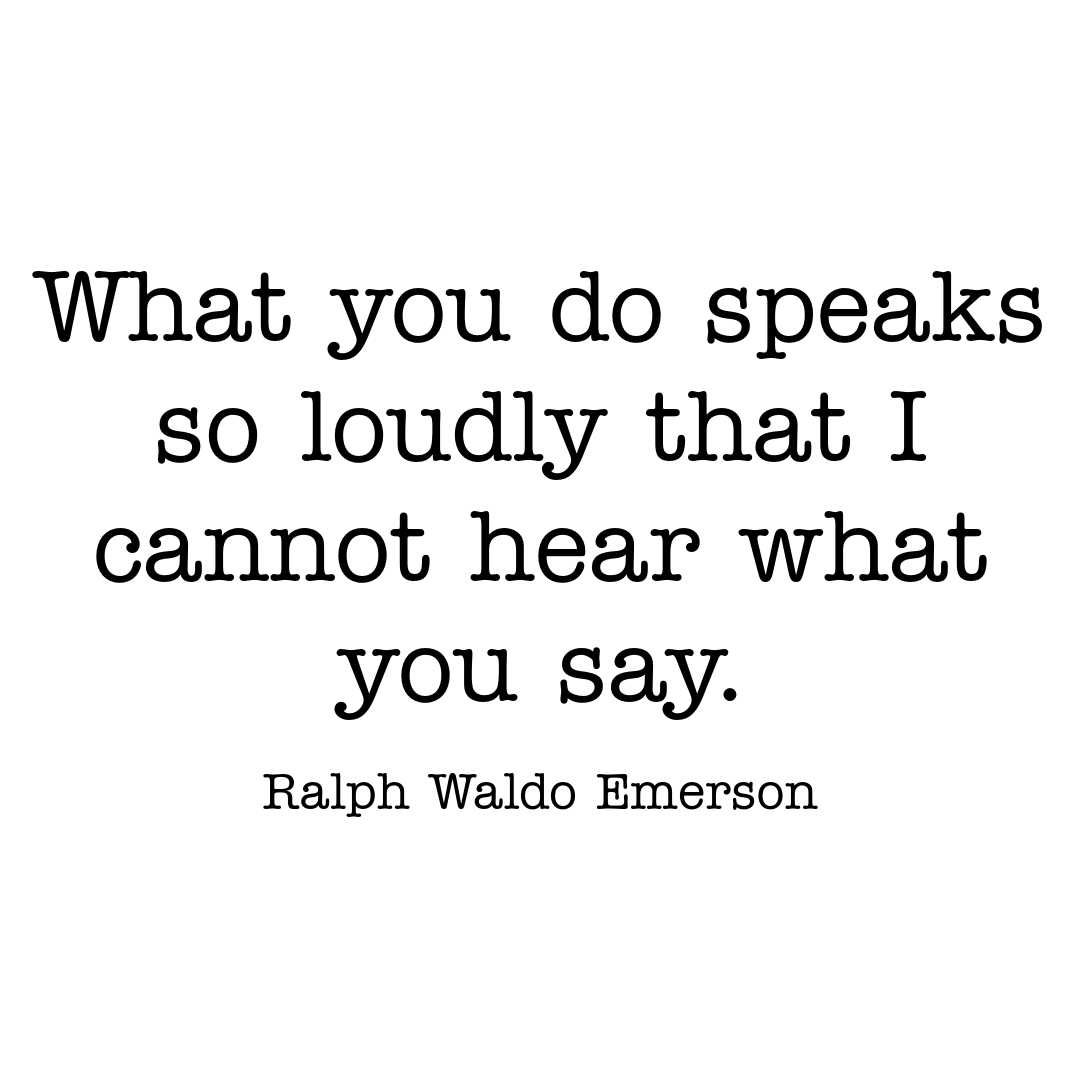
|What You Say| What you do speaks so loudly that I cannot hear what you say. Ralph Waldo Emerson
Actions reveal our true character far more than words ever could. Our values, intentions, and commitments are made clear through what we do. While words can inspire, it’s our deeds that truly make an impact. Strive to lead by example. Show kindness, integrity, and goodness in every action. Your consistent efforts and genuine behavior will speak volumes, influencing and inspiring those around you.
Embrace the power of action, knowing that each step you take creates a ripple effect, not just shaping the world, but also touching lives in profound ways. Let your actions align with your principles, creating a legacy of authenticity and positive change. By living your values, you become a beacon of inspiration, proving that authentic leadership and influence is demonstrated through what we do.
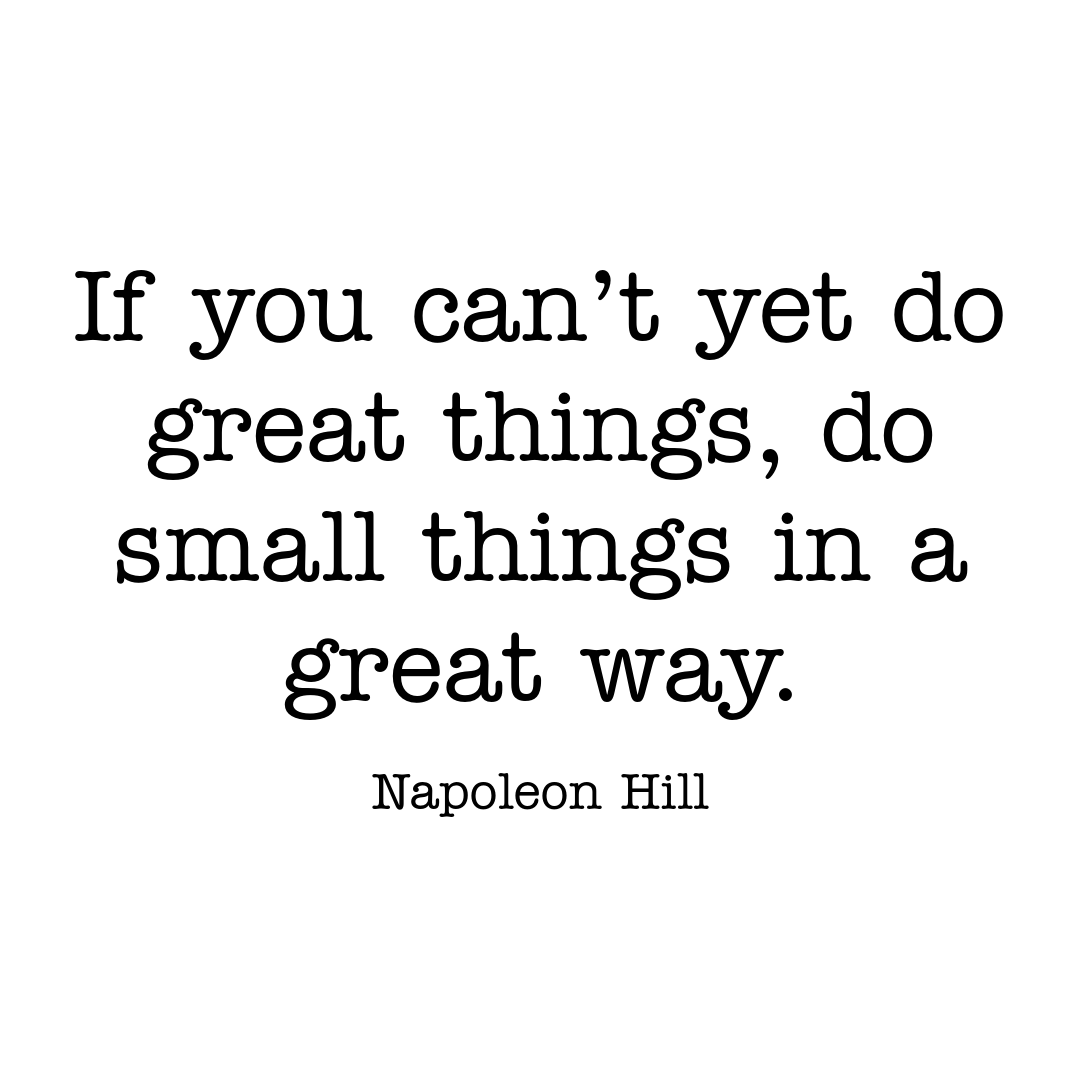
|Small Things| If you can’t yet do great things, do small things in a great way. Napoleon Hill
Greatness isn’t always about grand gestures; it’s often found in the small, consistent actions we take daily. Even if you’re not sure what the “big thing” is yet, focus on doing the little things with excellence. Your dedication to the details, your commitment to quality, and your passion in even the simplest tasks lay the groundwork for bigger successes. Each small step, taken with care and purpose, builds momentum and cultivates habits of greatness. Embrace every opportunity to shine, no matter how small.
Remember, small efforts, when done consistently, can lead to significant accomplishments. Stay dedicated, take pride in your work, and trust that your small, great actions today are paving the way for a remarkable tomorrow.
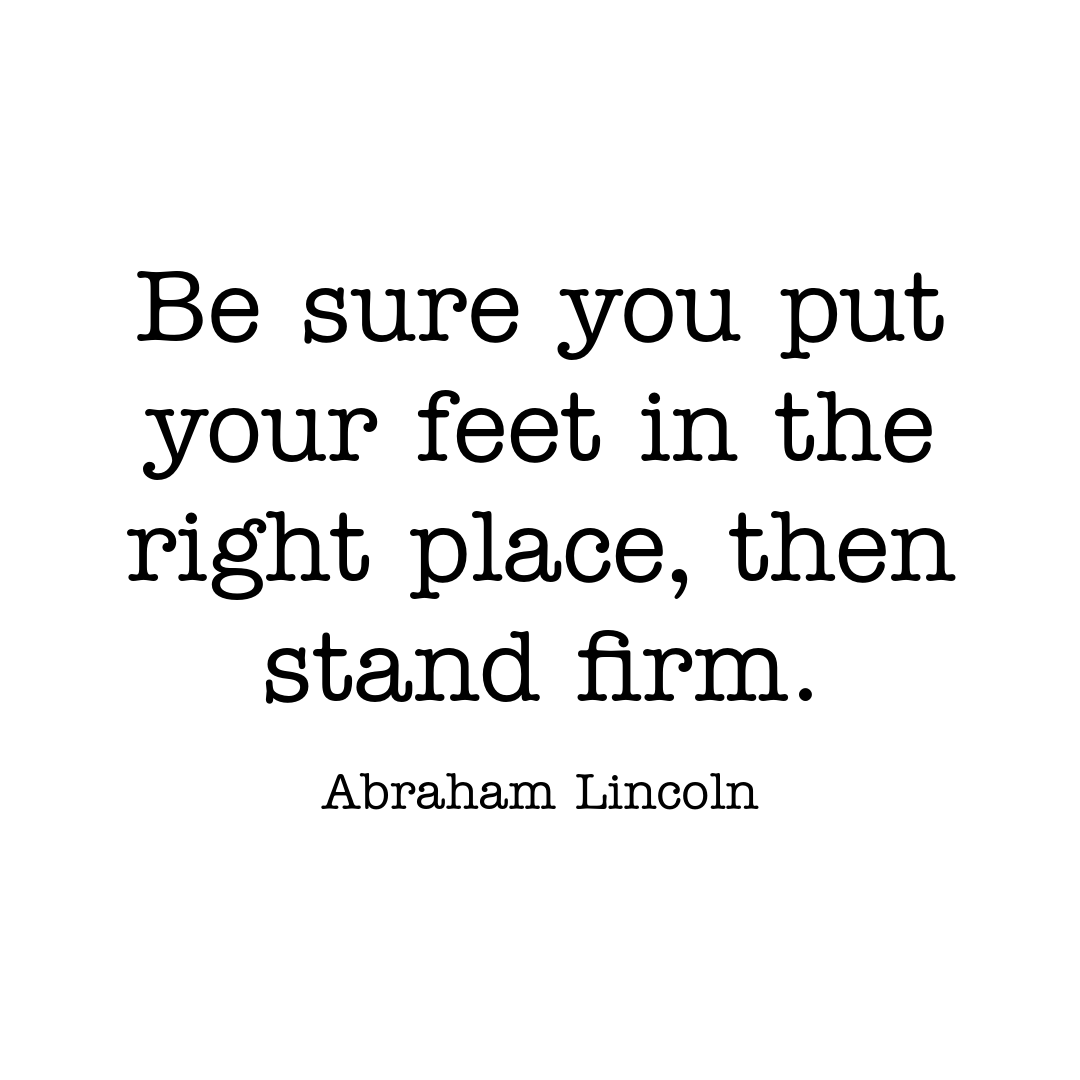
|Stand Firm| Be sure you put your feet in the right place, then stand firm. Abraham Lincoln
Recently, I’ve been reading about foundations. The foundations that shape us…that sustain us. Success often starts with a solid foundation. Taking time to find a solid and trustworthy foundation ensures every step points you to the desired result. Once you understand your purpose, commit to it wholeheartedly. Challenges will arise, but standing firm in your beliefs and goals will see you through.
Remember, strength isn’t just about moving forward; it’s also about staying steadfast when the journey gets tough. Embrace your path – your calling with confidence, knowing that with every step rooted in that foundation of who you have been called to be, you’re building a future rooted in authenticity. Stand firm in your purpose.










 Be encouraged