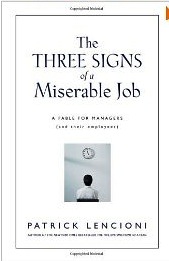
The Three Signs of a Miserable Job (Review)

Of the three Lencioni books I’ve read so far, this was my least favorite. That’s not to say I didn’t like the book, just that it wasn’t my favorite. As with his previous books, the first three-quarters are a fable – a story, that demonstrates the problems, the process of defining and implementing the solution as well as some potential difficulties you may encounter in your use of the solution(s). The remainder of the book is dedicated to the practical explanation and tips for implementation.

For the first time, the fable for this book seemed a bit farfetched, but perhaps that’s do to my limitations rather than reality. Although I did appreciate that my home town of Eugene, OR got a shout out in the story.

The premise of the book is that and his model, unless there is relevance (who are you and your work important to), measurable aspects of your job (how do you ‘know’ if you did a good job today) and a lack of anonymity (the folks you work with need to know you and you need to know them) your job will be less than fulfilling – even miserable.

While the principles may seem simplistic, the real challenge, in my opinion, is the implementation and definition of each of these traits for each of the staff you’re working with. To his credit he give more explanation to this point in the story than he does in previous books. Also, there are several supporting tools available on his website The Table Group.

My Rating 3 out of 5.
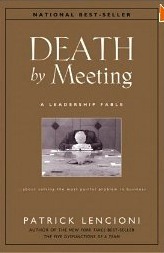
Death by Meeting – (Review)

For as much as I liked 5 Dysfunctions of a Team (the first Lencioni book I read), I liked this one even more. Not only does he have a great ability in storytelling, but I also started to notice that the principles he’s presenting also help shape the book. This was a great read that is super practical. you can very easily and quickly begin to see how you could begin to incorporate the ideas in to your work schedule. I highly recommend this book.

My Review: 5 out of 5.  Whereas the last book I was reading took weeks to finish, I finished this in just a few days. Great storyline – even better principles for your professional life. If you meet with folks on any kind on a regular basis, this is a must read.

Linchpin Review

LinchpinI was really looking forward to jumping into the book. The first 2/3 to 3/4 had really great thoughts and challenges that I was able to really start to employ (or at least start thinking about in ways I had not previously). Where I did get disappointed was towards the end where it felt like many of the great topics could have been developed and discussed more. It felt like they got short-changed and he was in a hurry to finish the book.
Still very good. One that is probably worth reading several times over.

The Five Dysfunctions of a Team: A Leadership Fable

The Five Dysfunctions of a TeamJust finished this one. Great read. First time I’ve read anything from Patrick Lencioni. From what I’ve been told many of his other books have a similar format. He tells a story (the Fable) that is interesting in its own rite, and uses it to set up the lesson(s) to be learned. Then he provides some practical discussions and exercises on how to overcome the Five Dysfunctions of a team. I really enjoyed this and I’m looking forward to adding a few more Lencioni titles to my repertoire. Add this to my “highly recommend” list.

One of my favorite quotes from the book, “If you make everything important, then nothing is important.”

Jim Breuer: I’m Not High

I'm Not HighJust finished the book. Great read. Good laughs. Surprisingly real and genuine.

Uncommon

UncommonFor Christmas I received Uncommon Finding Your Path To Significance by Tony Dungy.

A few of my favorite quotes from the book:

“What you do is not as important as how you do it. Those are the words that keep coming back to me when I am tempted to choose what is expedient of what is right” Uncommon, Chapter 1

“Character may be manifested in the great moments, but it is made in the small one”, wrote Phillips Brooks, an American clergyman in the 1800s. Over time, we create ourselves and build our character though the little acts we do.” Uncommon, Chapter 1

“Integrity is what you do when no one is watching; it’s doing the right thing all the time, even when it may work to your disadvantage. Integrity is keeping your word. Integrity is that internal compass and ruder that directs you to where you know you should go when everything around you is pulling you in a different direction. Some people think reputation is the same thing as integrity, but they are different. Your reputation is the public perception of your integrity. Because it’s other people’s opinions of your, it may or may not be accurate. Others determine your reputation, but only you determine your integrity. Integrity is critical to everything we do because it is the foundation of trustworthiness in our own eyes, in the eyes of those around us, and in God’s eyes.” Uncommon, Chapter 2

“From the moment you are born, you- and you alone- determine whether you will be a person of integrity. Integrity does not come in degrees – low, medium or high. You either have integrity or you do not.” Uncommon, Chapter 2

The Switch Framework – How To Make A Switch

I recently finished reading Switch by Chip and Dan Heath. Overall good read. Practical information told well with the right amount of humor and case studies to make it fun and interesting.

In short, here is the summary of the principles:

For things to change, somebody somewhere has to start acting differently. Maybe it’s you, maybe it your team. Picture that person (or people).

Each has an emotional Elephant side and a rational Rider side. You’ve got to reach both. And you’ve also got clear the way for them to succeed. In short you must do three things.

Direct The Rider

  • Follow The Bright Spots. Investigate what’s working and clone it.
  • Script The Critical Moves. Don’t think big picture, think in terms of specific behaviors.
  • Point To The Destination. Change is easier when you know where you’re going and why it’s worth it.

Motivate The Elephant

  • Find The Feeling. Knowing something isn’t enough to cause change. Make people feel something.
  • Shrink The Change. Break down the change until it no longer spooks the elephant.
  • Grow Your People. Cultivate a sense of identity and instill the growth mind-set.

Shape The Path

  • Tweak The Environment. When the situation changes, the behavior changes So change the situation.
  • Build Habits. When behavior is habitual, it’s “free” – it doesn’t tax the Rider. Look for ways to encourage habits.
  • Rally The Herd. Behavior is contagious. Help it spread.
Currently I’m a few chapters into Drive – The Surprising Truth About What Motivates Us by Daniel H. Pink. I’ll keep you posted.

A Few Notes From Switch

A few thoughts as I’ve been reading through Switch by Chip and Dan Heath. I haven’t finished the book yet, and I’ll post more as I go along.
Here are a few points I’ve found interesting so far…

  • To change behavior you have to change the situation
    • Often our heart and mind disagree and limit our ability or willingness to change.
  • Direct the “rider”
    • What looks like resistance is often a lack of clarity.
    • Provide clear direction.
  • Motivate the “elephant”
    • What looks like laziness is often exhaustion.
      • Self-Control or the gut-it-out, grit-through-it, will-it-into-reality is an exhaustible resource.
    • You can force but only for a short while. Engage people’s emotional side.
  • Shape the Path
    • What looks like a “people problem” is often a situation problem.
    • When you shape the path, you make change more likely not matter what is happening with the rider and/or the elephant.

In tough times, a rider will see problems. You must remain solution-focused.

  • Solution Focused Problem Solving
    • Q: If a miracle happened tonight and went problem went away, what is the first sign you would see to know it was gone?
    • Q: When was the last time you saw a little bit of the miracle?

Too many options and ambiguity lead to decision paralysis.

  • In a change situation, the hardest part is in the details – Script the critical moves.
  • Clarity dissolves resistance.