
Speaking Their (Love) Language: A Simple Guide to Love and Appreciation

I’ve had the opportunity to lead several small groups and team meetings based on the ideas presented in 5 Love Languages and the workplace-centric version, 5 Languages of Appreciation. Understanding the needs and communication styles of those you’re around makes nearly everything easy, better, and more meaningful. 

The Five Love Languages (5LL) by Dr. Gary Chapman was released in 1992. Chapman introduced the framework to help individuals express and receive love and appreciation in meaningful ways. Initially, 5LL focused on personal relationships. In 2011, Chapman worked with Paul White to apply these principles in the Workplace by releasing 5 Languages of Appreciation in the Workplace (5LA). While helpful in the Workplace, special considerations are needed.

In my experience, I’ve seen 5LL/5LA improve communication, strengthen relationships, and enhance trust.

What Are the 5 Love Languages

The 5 Love Langues are:

  • Receiving Gifts
  • Words of Affirmation
  • Quality Time
  • Physical Touch
  • Actions of Service

The acronym GATTS (Gifts, Affirmation, Time, Touch, Service) can be used as a reference.

Let’s talk about each in that order.

Receiving Gifts

People with this Love Language are often incredible gift-givers. For them, it’s not necessarily the magnitude or the frequency of a gift but the thoughtfulness of the gift. Chapman says, “Visual symbols of love are more important to some people than others” and that gifts can represent “A Reminder of Love.”

Examples

  • Bringing a coffee to a friend or colleague. Not just any coffee but THEIR coffee with the double shot, half-caf, oat milk medium in a large cup, double-sleeve coffee.
  • Celebrating wins and milestones with them. Is their thing Dungeons & Dragons or Xbox? How could that inform the token of your appreciation?
  • At work, it could include using Time Off as a gift – letting them come in late on a particular day, have a longer lunch, or leave early for a family event.
  • What’s their favorite movie, candy bar, or band… any of these (or thousands of other alternatives) could be used to celebrate and recognize them and their contributions.

Words of Affirmation

People who are built up by and encouraged with Words of Affirmation and respond to verbal or written expressions of praise and appreciation. Like gifts, these need to be genuine, authentic, and intentional. In order to speak this love language, sometimes the mantra “Words Are Important!” needs to always be on our mind or a post-it note on the mirror.

You might say, “But they should know… why should I have to keep telling them… I’ve told them before… just do your job…” As one who greatly values Words of Affirmation, I can tell you it’s much like a plant that withers as it lacks the water, sunlight, and oxygen it needs to live. Your decisions influence getting their best or a reserved (or injured) result.

When offering Words of Affirmation, Paul White adds, “…give words of affirmation that focus on the character of another individual. Character looks beyond performance and focuses on the inner nature of the person.”

Examples

  • Publicly recognizing their efforts during a meeting, group conversation, or in front of family members. Remember: You’re doing this for them – not for you to look or feel good. This is about speaking their love language. Check your motive.
  • A thoughtful and intentional email or text at the right time can mean more than you realize. (Pro Tip: Go next level and write them a handwritten note.)
  • Offer encouragement to them when it’s not going well when they are discouraged or down. Your words are powerful. Use your words to create life.
  • Thank someone for something they do routinely – something they may feel gets overlooked and/or underappreciated. Sometimes, receiving a compliment in an area where it’s unexpected can have the most value.

Quality Time

Quality Time emphasizes time – but time that isn’t distracted and purposeful to make someone feel valued. An often overlooked aspect of Quality Time is your ability to listen and be present. This could include meaningful conversations without your phone, looking them in the eye, and connecting with them. Sometimes, it’s sharing a space and reinforcing proximity (you’re not alone – I’m here with you). 

If Quality Time is your love language – you know when it’s being met and when it’s not. It may look the same from the outside, but there is Quality Time, and then there is just time. If fairness, when the other person is missing on the “quality” aspect, you have to communicate this with them and not just expect them to “figure it out.” 

Chapman provides this summary in identifying Quality Time: “The essential ingredients in a quality activity are: (1) at least one of you wants to do it, (2) the other is willing to do it, (3) both of you know why you are doing it – to express love by being together.”

Examples

  • Doing regular one-on-one meetings, allowing time for more meaningful interaction and discussion that talks about goals and feedback.
  • Listening attentively during the conversation – not rushing ahead, trying to get to the end, immediately jumping to “the fix,” and not getting distracted by your phone or projects. Maintain eye contact. Being intentional this way can help prevent your mind from wandering.
  • Creating space and time so they know they are heard and not alone. Rarely do they need you to fix the thing they are sharing with you – they are looking for a meaningful connection. 
  • Make time every day to share some of the day’s events with each other. It seems simple and obvious, but how often does the news or social media get your attention before the person right in front of you?

Physical Touch (Adapted for Workplace Appropriateness)

Touch can communicate trust, caring, empathy, and connectedness.

In personal relationships, there are so many subtle ways to communicate love and appreciation through physical touch – holding hands, a hug, resting your hands on their shoulders, putting your hand on their arm as you reach around them to pick something up. All of these (and the accumulation of these small touches) can be very profound for those moved by physical touch.

In the office, what is appropriate is much different. Ultimately, it comes down to what they consider appropriate and welcome – not you. For you, a pat on the back is no big deal – to someone else who may be crossing a border, that is not acceptable. 

Examples

  • Offering a handshake or fist bump to celebrate.
  • Giving a high-five or pat on the back in the moment of achievement.
  • Non-physical gestures, like a thumbs up, are a way to communicate encouragement.

Especially in the Workplace, touch can be controversial. The key is understanding what is appropriate, welcomed, and acceptable as defined by them, not you.

Acts of Service

This language places a priority on being helpful in practical ways of support, often to alleviate challenges for others. These are your “givers”. They seem to intuitively understand how to make your day better or more satisfying. They can also be quick to meet your needs and just as quick to neglect their own and can struggle with boundaries. Acts of Service is one of my key love languages. I can tell you all the great things about it, but I can also point out some real pitfalls associated with being so “others-centric.” Acts of Service does not mean that you’re a doormat or a people-pleaser or that you should abandon your boundaries. Remember that love is freely given. It’s not coerced or demanded. If it’s a forced act, it’s likely to be compliance rather than love/appreciation.

Sometimes, doing what we think needs to be done can cause more damage than help. The answer…ask? “What would be helpful to you?” “How would you like this task to be done?” “When would be the best time to help?”

Examples: 

  • Helping out with a time-sensitive project.
  • Taking care of that chore or task around the house as a thoughtful expression of their appreciation for you.
  • Running “interference” for them so they can focus on the project, event, Super Bowl, movie, etc.
  • Finding small but significant ways to ease your stress.

“What’s my Love Language…”

Understanding your love language and learning those of your spouse, family, friends, and colleagues is incredibly valuable (more on this in a moment). So how do you determine your love language?

  • Reflection: Start with Self-reflection: Think about the times you’ve felt most valued and appreciated. What made you feel that way? Someone bought you a small gift they knew you’d like. Jump in to help with a project. These are good indicators to consider. We’ve often not spent the time thinking about it or putting language around it. 
  • Observation: Secondly, take stock of the things you do to communicate your affection or appreciation to someone. Often, the way WE communicate love is a reflection of how we best FEEL love. “…of course, they’ll feel appreciated this way… I do when someone does that for me… how could they not feel appreciation from that?” This may not be perfect, but it can be a good indicator.
  • Assessment: Finally, you can do a free online assessment here or here.
    • Note: An assessment tool is available for the workplace/5 Languages of Appreciation, but it is a paid service. If interested, you can access it here (I do not receive any compensation or benefit from this – I’m only passing the link along to you for your review and consideration.)

Why Understanding the 5LL/5LA is Valuable

Ok, so you’re intrigued. The idea of communicating your affection and appreciation in a meaningful way to someone (that may be different than how you like to receive affection and appreciation) resonates with you… but does it really make a difference?

I could point to many examples of improved morale, increased production, and less turnover in the Workplace. At home or in your personal relationships, I could talk about improved communication, enhanced trust, and a deepened sense of empathy. All of which would be true. 

That said, applying 5LL/5LA genuinely and authentically allows the other person to feel seen, heard, and understood. I’ve never been in a situation where, when someone felt more seen, heard, or understood, the situation and/or relationship weren’t substantially improved.

Warning

As French philosopher Voltaire (and Spiderman) said, “With great power comes great responsibility.” The 5LL/5LA is not a tool to use and get what you want. When misapplied or abused, they can cause irreparable damage. When abused or misused, the 5LL/5LA look like: 

  • Receiving Gifts: Extravagant or impersonal gifts can make people feel uncomfortable or manipulated.
  • Words of Affirmation: Insincere or generic praise can feel empty and shallow.
  • Quality Time: Excessive demands on someone’s time may feel invasive and push them away or cause them to shut down.
  • Physical Touch: Unwelcomed or inappropriate touch can cross boundaries (personal and cultural) and cause discomfort or misinterpretation.
  • Actions of Service: Overextending yourself can lead to your burnout and/or their dependency.

Developing trust and maintaining awareness and sensitivity (aka “Read the Room”) is the key to using 5LL/5LA effectively. When in doubt, ask.

Now What

As I’ve talked with teams, small groups, friends, and family about the 5 Love Languages, it is always a valuable lens to learn about others and has created interesting and insightful conversations. The first step is to understand your love language and understand how to recognize preferences in others. Take the test and see what you learn.

Additional Resources:

Servant Leadership – My Version of an Introduction

When “leadership” is mentioned, many ideas can come to mind. Vision. Decisiveness. Strength. Strategic. Competitive. All of these may be accurate. Many are desirable, but some, depending on how they are portrayed, may not.

Two ideas have influenced my perspective on leadership. The first came from my business coach, who said, “The accumulation of little things is often more impactful than the one ‘big thing.'” The second is a succinct quote from John Maxwell: “Leadership is Influence.” These quotes added nuance to my experiences with the leaders in my life—both good and not-so-good. They have also led me to the ideology and approach to leadership called Servant Leadership.

Servant Leadership

Robert K. Greenleaf formalized the idea of Servant Leadership in a series of essays. The term Servant Leader was introduced in an essay called The Servant as Leader, published in 1970. From the first time I read about it, the approach of Servant Leadership resonated with me. It aligned with my values and my view of people.

Greenleaf’s ideas were, in part, inspired by Hermann Hesse’s novel The Journey to the East (1957). In Hesse’s story, the character Leo embodies servant leadership. He starts as a servant to a group of travelers. (Warning: Spoiler Alert!) Later, it’s revealed that Leo is the spiritual leader of a secretive group called the League. The parable teaches that leadership isn’t about title or role; it’s about serving and uplifting others.

Applying Servant Leadership.

In his essay, Greenleaf has a line that resonates with me and, in my opinion, is the litmus test of being a leader:

Do those served grow as persons? Do they become healthier, wiser, freer, more autonomous, and more likely themselves to become servants?

My influence… my leadership, can be revealed in those around me. I care, support, serve, and influence them. I often miss the mark, but this is what I aspire to.

The Traits of a Servant Leadership

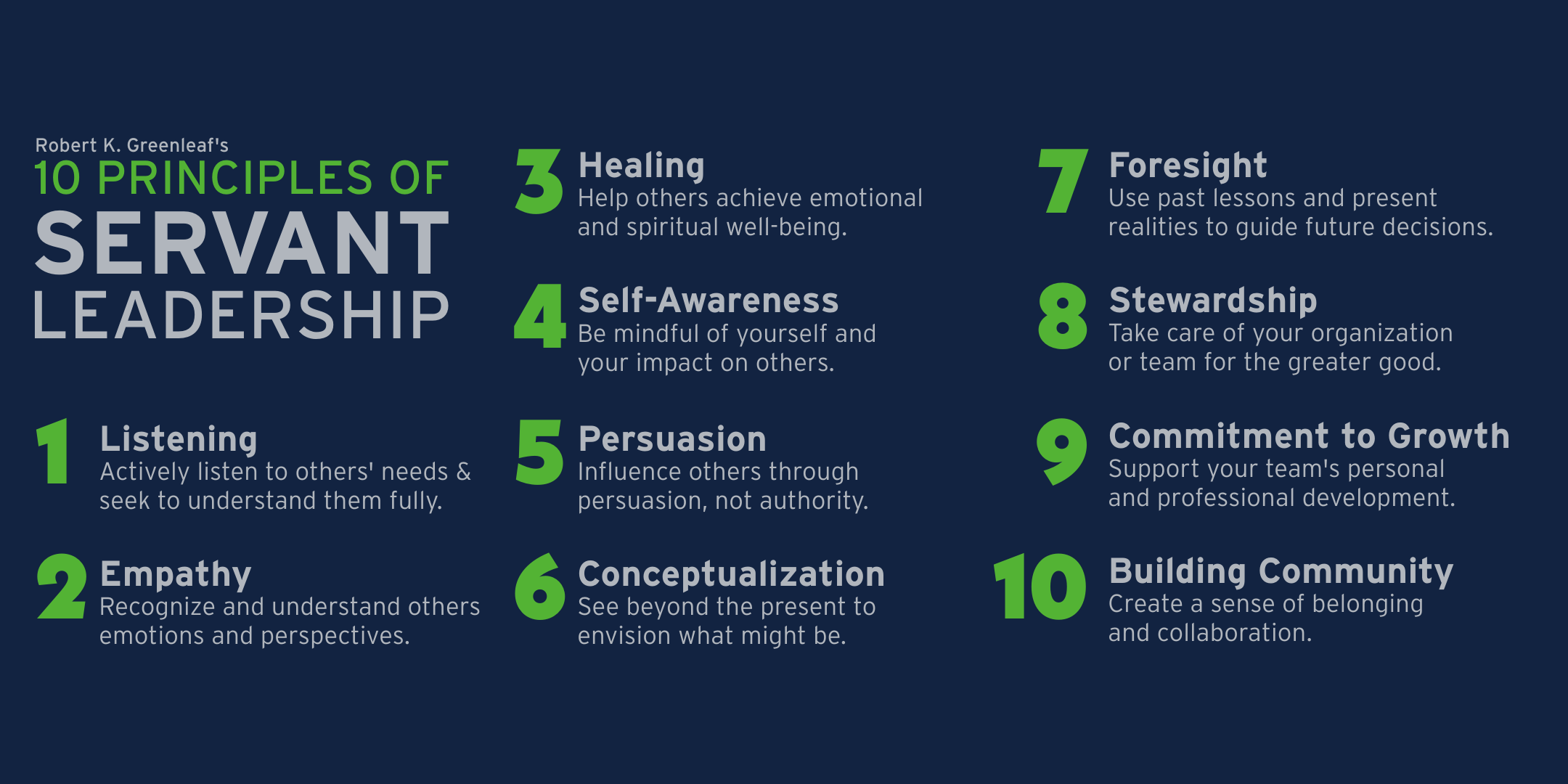
Greenleaf outlined ten traits of servant leaders:

  1. Listening: Actively listen to others’ needs and seek to understand them fully. Often, this requires that we listen more than we talk. Consider more than we persuade. This leads nicely to the next trait…
  2. Empathy: Recognize and understand others’ emotions and perspectives. Alfred Adler described empathy as “Seeing with the eyes of another, listening with the ears of another, and feeling with the heart of another.”
  3. Healing: Help others achieve emotional and spiritual wellbeing. This idea might lead you to the thought, “… but that’s…*EMOTIONAL*… this is work! Can’t we just avoid emotions and do work…” I’ll let you decide if those things can be separated.
  4. Self-Awareness: Be mindful of yourself and your impact on others.
  5. Persuasion: Influence through persuasion, not authority.
  6. Conceptualization: See beyond the present to envision what might be. Another way to think of this is “looking forward.”
  7. Foresight: Use past lessons and present realities to guide future decisions. Another way to think of this is “looking back.”
  8. Stewardship: Take care of the organization or the team for the greater good.
  9. Commitment to the Growth of People: Support your Organization’s/Team’s personal and professional development.
  10. Building Community: Create a sense of belonging and collaboration. We were made for community.

I’ve seen and read an additional trait that other students of servant leadership have added:

Bonus: Calling: You are the right person, at the right time, for the right reason. You may not feel like a “leader” or even want to be one. But for whatever reason, you are in the position you are, with the influence you have for a reason. Embrace it.

Leadership is not always “the one big thing.” Very often, it presents itself in the collection of small things done well and consistently.

In his book Atomic Habits, James Clear said,

“Every action you take is a vote for the type of person you wish to become. No single instance will transform your beliefs, but as the votes build up, so does the evidence of your new identity.”

This applies to becoming the leader you want to be and that those around you want you to be.

Myths of Servant Leadership

As I’ve studied servant leadership, I have seen opponents to the idea because it’s so contrary to “traditional leadership.”  A few examples include:

Servant Leadership is just “easy” or “being everyone’s friend.” I can appreciate the thought process to get there when I hear this, but I disagree with the conclusion. A quote I recently read provided a great response. In his book Know What Matters, Ron Shaich says,

“Servant leadership isn’t about being nice at all costs. It’s about being helpful at all costs. And radical honesty is a much greater service to people than simply being kind.”

Servant Leadership is just a “Christian/religious thing.” Without a doubt, there is a spiritual quality to servant leadership. Many people will point to Jesus’s quote, “Jesus called them together and said, “You know that the rulers of the Gentiles lord it over them, and their high officials exercise authority over them. Not so with you. Instead, whoever wants to become great among you must be your servant, and whoever wants to be first must be your slave— just as the Son of Man did not come to be served, but to serve, and to give his life as a ransom for many.” Matthew 20:25-28

Servant Leadership is seen in quotes from teachers of many faiths:

  • Mahatma Gandhi: “The best way to find yourself is to lose yourself in the service of others.”
  • Dalai Lama: “Our prime purpose in this life is to help others. And if you can’t help them, at least don’t hurt them.”
  • Thich Nhat Hanh: “The practice of compassion and loving-kindness is not about being nice but about being real and truthful, helping others to transform their suffering.”
  • Prophet Muhammad: “The leader of a people is their servant.”
  • Guru Nanak: “The essence of life is to serve others and do good.”

Servant Leadership Sacrifices Results for Relationships: Simply because you focus on people and their well-being and growth doesn’t mean you ignore outcomes. My experience is that when you focus on people, you have better outcomes, able to stand to adversity and challenges, and can do it faster (Ref. Steven Covey, The Speed of Trust)

Alternatively

When creating training content on servant leadership, I got a weekly email from Inc. magazine. The email provided a link to an article called “5 Signs That Instantly Identify Someone With Bad Leadership Skills. The list included:

  1. Narcissistic Tendencies
  2. Not recognizing their people for good work.
  3. Treat people like numbers
  4. Too much control
  5. Not sharing information

I found this list and these traits interesting compared to the material I was preparing. When servant leadership is demonstrated well, people are drawn in and thrive.

Your Influence Matters

I believe we’re all here for a reason. I believe you’re in the situation you’re in—good or bad, challenging or encouraging—for a reason. You have the opportunity to learn. You have the opportunity to serve. It’s about choosing to do the small things that build trust, inspire others, encourage others, and foster gratitude in others and yourself. By focusing on the well-being and development of others, we can make a lasting impact—not just as leaders but as human beings. One last quote to drive this point home, Donald McGannon says,

Leadership is an action, not a position.

Lead with intention, serve with humility, and influence with purpose.

Be Encouraged. Be an Encourager.

If you’re interested, here is a version of the slide deck I’ve used to present the ideas of servant leadership.
Servant Leadership Slide Deck

Servant Leadership Traits – Desktop Reminder. I have this sitting on my desk at all times.

OKRs – My Version of an Introduction

There are a lot of articles, videos, and books about Objectives and Key Results (OKRs). Here’s how I talk about OKRs.


OKRs are a tool to help with organizational alignment to focus on what is most important to accomplish in the next three, six, or 12 months. OKRs were popularized by tech companies like Google. As discussed in his book High Output Management, the concept’s genesis came from Andy Groves at Intel. The modern iteration of the idea is discussed in the book Measure What Matters by John Doerr. According to the book, Doerr is the one who introduced the concept to Larry Page and Sergey Brin in the early days of Google.

What are OKRs?

OKRs consist of two main variables:

Objects: These are aspirational and qualitative goals describing WHAT you want to achieve.

Key Results: These quantifiable metrics measure progress and create visibility. They are specific, time-bound, and measurable. To ensure they are on point, the phrase “as measured by” can often be included with Key Results.

Nonprofit organization OKR example: Improve Volunteer Engagement:

Objective: Increase volunteer engagement to boost program effectiveness and satisfaction.

Key Results

  1. Increase volunteer engagement activity scores by 20% by December 31st.
  2. Increase new volunteer sign-ups by 10% by the end of 1st Quarter.
  3. Achieve a 90% volunteer satisfaction rate by the end of 2nd Quarter.

For-profit organization OKR example: Increase Customer Satisfaction:

Objective: Improve customer satisfaction and loyalty.

Key Results:

  1. Resolve 95% of customer issues within 24 hours by the end of 1st Quarter.
  2. Increase Net Promoter Score (NPS) from 70 to 85 by the end of the 2nd Quarter.
  3. Conduct customer satisfaction surveys after each interaction and achieve a 4.5/5 average rating across all product lines by the end of the 2nd Quarter.

OKR Superpowers

In Measure What Matters, Doerr describes four Superpowers of OKRs

  1. Focus and Commit to Priorities
  2. Align and Connect for Teamwork
  3. Track and Accountability
  4. Stretch for Amazing

OKRs For-profit and Nonprofit Organizations

While the OKR framework can work across all landscapes, the implementation and focus can differ between For-Profit and Nonprofit organizations.

Similarities

  • Clarity: Regardless of the type of organization you are in, OKRs bring to what is important and create alignment across teams.
  • Results: OKRs track measurable outcomes and focus on the results.
  • Agility: Based on the reporting and results, OKRs can quickly adjust to reflect changes in the landscape.

Difference

  • Focus: For-profits often focus on revenue, customer satisfaction, or process improvement. In contrast, nonprofit OKRs are frequently mission-centric, prioritizing community impact, fundraising, or volunteer engagement.
  • Beneficiaries: Nonprofits align more towards donor expectations and program participants, whereas a for-profit aligns towards shareholder value.
  • Resources: Nonprofits frequently face challenges and constraints in funding and staffing. This can require some creative problem-solving to set realistic key results.

Steps to Implement OKRs

  • Understand the Purpose of OKRs
    • Help others understand that OKRs are a tool for setting and tracking goals, driving focus, alignment, and engagement within the organization.
    • Ensure that your leadership team and employees understand the value and purpose of OKRs.
    • Often, OKRs are a new idea, so the “Why” is as important (if not more so) than the “What” or the “How”.
  • Define the Objective
    • Identify a high-level, qualitative goal that highlights an area of improvement or strategic priority for the organization.
    • Make sure the objective is aspirational and clear.
  • Align Team and Individual Objectives
    • The organizational objective will cascade down and inform the team objectives, which will cascade down and inform the individual objectives. If they don’t, you’ll have a misalignment, confusion (probably frustration and lack of engagement), and, likely, miss achieving your objective.
  • Set Measurable Key Results
    • I have found the most success in using 2-4 Key Results. Some will argue for more, but the value of OKRs is to create focus. “If everything is important, nothing is important.”
    • Make sure the Key Results are specific, time-bound, and challenging yet achievable. Including the team in creating the OKRs often provides a better outcome.
  • Communicate the OKRs
    • I’m an advocate for having as much of the organization/team as possible involved in creating the OKR for greater buy-in from the start. Regardless, once the OKRs are created, transparency and communication are essential. A kickoff meeting or presentation can be valuable.
      • One organization I worked on OKRs with, each team completed their OKR launch with a skit describing their objective and key results. It was fun and informative.
  • Track and Report on Progress Regularly
    • DON’T Overcomplicate this. A simple solution is better than no solution. There are a lot of tools and software platforms out there. While helpful, a simple spreadsheet can get the job done as effectively.
    • The important thing is to have a regular cadence (weekly, biweekly, or monthly) to report on progress, address roadblocks, and adjust as needed.
  • Evaluate and Reflect
    • The person who first introduced me to OKRs would often say, “Win or Lose, watch the tape.” Take time with your team to review the results, discuss successes, and identify areas for improvement.
    • Remember “Stretch for Amazing” – even if you didn’t achieve 100% of your goal, how much improvement and/or growth has been realized? Celebrate!
  • Iterate and Improve
    • Use what you’ve learned from this round of OKRs to help inform and improve your next OKR cycle. OKRs are living tools – not a “set ’em and forget ’em” approach.
    • You’re always looking for ways to improve over what you did last time. As you grow and strengthen your OKR proficiency, you’re set up to make more impactful and meaningful OKRs for your organization.

Some Common Mistakes

I’ve led a lot of conversations and OKR implementations. I have had and seen great success. I’ve also made a lot of mistakes. Here are a few things to consider and avoid:

  • Don’t Set Too Many Objectives: Focus. Focus on a few priorities to avoid spreading you, your team, your organizations, or your resources too thin.
  • Be Specific: Vague Key Results can sometimes sound great, but in the end, you realize you didn’t really know what you were aiming at. Keep Key results specific and measurable to track progress. Remember: “…as measured by…”
  • Get Buy-In Early, Often, and Throughout: Engage your team in the process and make sure everyone is bought and supports the idea. As a solo crusade, this can be a heavy rock to push if you’re the only one.
  • Align to Culture: Culture is a big deal for me. Your OKRs have to align with who you are as an organization. Don’t just copy/paste an OKR you found online. What does your organization need? How do you think/talk/solve that need?
  • Reporting on Progress: Drive on this until it’s an automatic habit. Regularly review and update on the progress of your OKRs to maintain momentum. In the midst of a problem or setback is the time to discuss it and solve it – not after.

OKRs are a proven methodology for:

  • Achieving focus and clarity
  • Creating alignment within the organization, teams, and locations
  • Provide visibility and transparency on progress, problems, and successes
  • Encourage a growth mindset and stretch your team and organization to achieve great things

OKRs can help you translate your vision into actionable steps. Start small, learn and adjust, and watch your organization grow.


How to Write Email with Military Precision

This is a discipline we have been working to use consistently in my Operational Group at Quantum.

Original post on Harvard Business Review

nov16-22169984846In the military, a poorly formatted email may be the difference between mission accomplished and mission failure. During my active duty service, I learned how to structure emails to maximize a mission’s chances for success. Since returning from duty, I have applied these lessons to emails that I write for my corporate job, and my missives have consequently become crisper and cleaner, eliciting quicker and higher-quality responses from colleagues and clients. Here are three of the main tips I learned on how to format your emails with military precision:

1. Subjects with keywords. The first thing that your email recipient sees is your name and subject line, so it’s critical that the subject clearly states the purpose of the email, and specifically, what you want them to do with your note. Military personnel use keywords that characterize the nature of the email in the subject. Some of these keywords include:

  • ACTION – Compulsory for the recipient to take some action
  • SIGN – Requires the signature of the recipient
  • INFO – For informational purposes only, and there is no response or action required
  • DECISION – Requires a decision by the recipient
  • REQUEST – Seeks permission or approval by the recipient
  • COORD – Coordination by or with the recipient is needed

The next time you email your direct reports a status update, try using the subject line: INFO – Status Update. And if you need your manager to approve your vacation request, you could write REQUEST – Vacation. If you’re a project manager who requires responses to your weekly implementation report from several people, type ACTION – Weekly Implementation Report. These demarcations might seem obvious or needlessly exclamatory because they are capitalized. But your emails will undoubtedly stand out in your recipient’s inbox, and they won’t have to work out the purpose of your emails. (It also forces you to think about what you really want from someone before you contribute to their inbox clutter.)

2. Bottom Line Up Front (BLUF). Military professionals lead their emails with a short, staccato statement known as the BLUF. (Yes, being the military, there is an acronym for everything.) It declares the purpose of the email and action required. The BLUF should quickly answer the five W’s: who, what, where, when, and why. An effective BLUF distills the most important information for the reader. Here’s an example BLUF from the Air Force Handbook:

BLUF: Effective 29 Oct 13, all Air Force Doctrine Documents (AFDDs) have been rescinded and replaced by core doctrine volumes and doctrine annexes.

The BLUF helps readers quickly digest the announcement, decision, and when the new procedures go into effect. The reader doesn’t necessarily want to know all the background information that led to the decision. He or she likely wants to know “how does this email affect me?” and the BLUF should answer this question every time.

For my corporate job, I don’t use the acronym “BLUF” because it would be unclear to recipients, but I have started leading with “Bottom Line” in bold at the start of my notes. Sometimes, I even highlight the bottom line in yellow so that my point is abundantly clear. Here is an example of a BLUF adapted for corporate use:

Subject: INFO – Working from home

Shannon,

Bottom Line: We will reduce the number of days that employees can work from home from three to one day per week effective December 1st.

Background:

  • This is an effort to encourage team morale and foster team collaboration
  • All members of the management committee supported this decision

Shannon knows that no response is required because it was marked INFO. She also quickly grasps the information in the email because of the Bottom Line. Because this is a big change in corporate policy, background details are provided to show that the decision is final, supported by management, and intended to result in positive effects for the company.

3. Be economical. Military personnel know that short emails are more effective than long ones, so they try to fit all content in one pane, so the recipient doesn’t have to scroll. They also eschew the passive voice because it tends to make sentences longer, or as the Air Force manual puts it, “Besides lengthening and twisting sentences, passive verbs often muddy them.” Instead, use active voice, which puts nouns ahead of verbs, so it’s clear who is doing the action. By using active voice, you are making the “verbs do the work for you.” Instead of, “The factory was bombed by an F18,” military professionals would say, “An F18 bombed the factory.”

Even though short emails are usually more effective, long emails abound, even in the military. If an email requires more explanation, you should list background information after the BLUF as bullet points so that recipients can quickly grasp your message, like in the above example.

Lastly, to prevent clogging inboxes, military professionals link to attachments rather than attaching files. This will force the recipient to check the website that has the attachment, which will likely provide the most recent version of a file. Also, the site will verify that the recipient has the right security credentials to see the file, and you don’t inadvertently send a file to someone who isn’t permitted to view it.

Here is an email example for corporate use that uses keywords in the subject, bottom line, background bullets, and active voice:

Subject: INFO – Meeting Change

Shannon,

Bottom Line: We scheduled the weekly update meeting for Thursday at 2 PM CST to accommodate the CFO’s schedule.

Background:

  • We searched for other available times, but this is the only time that works, and it’s important that you are on the call, so that you can address your P&L.
  • CFO will be in Boston on Thursday meeting at an offsite with the management committee.
  • He wants to review the financial report that can be found here (insert link) before the call.

By adopting military email etiquette, you will introduce a kernel of clarity to your correspondence and that of your colleagues and clients.

3 Simple Rules to Increase Your Leadership Communication

Formulate a Winning Argument: Simply Put, Less ACTUALLY is More

Original post on inc.com

CREDIT: Getty Images
Those in supervisory roles often believe that complexity equates to intellect. Making something too simple shows a lack of intelligence. The reality is that it takes confidence to simplify. Einstein said that the “highest level of intelligence is SIMPLE.” Failure to simplify really shows a lack of confidence. We call this the Too Simple Syndrome.

Coach John Wooden often said, “The biggest mistake coaches make is they over-coach.” This is absolutely true for formulating arguments and presentations. The biggest mistake people make is trying to over-teach. Other people are not as expert as you on your subject, and they do not need to be. Avoid the Too Simple Syndrome, and show confidence in the simplicity.

A client of mine had the task of convincing some higher-ups of the need for an expensive, but necessary, software for his firm. The leaders who had to sign off on the purchase had little knowledge of the software or the process that the software would simplify. My client prepared and polished a presentation explaining the ins and outs of the software, and why it would greatly improve the efficiency and profitability of the firm.

Having been so diligent to ensure that every detail was carefully outlined and explained, my client was surprised and frustrated to find that many people asked questions and expressed doubts that were clearly covered in his presentation. He said to me, “These people just don’t listen. It’s so obvious that the firm needs this software, but they want to kill the project anyway.”

My client made the common mistake of assuming that everyone else is as expert as you on your area of expertise. It seems so obvious, but so many people grossly overestimate the level of understanding from other people. Once we become expert on a subject, it is difficult to remember what it was like to be a novice. It is incredibly common to make the mistake of trying to sway others to your argument by educating them on the complexities, thinking they will follow your logic and reach the conclusion you want. This mentality might seem to make sense, as it is beneficial for others to know that you have a deep level of understanding on a topic, but trying to bring others into too deep a level is a losing battle.

Follow these three simple rules to increase your leadership communication:

1. Identify Your “3 Most Important”

Stick to the Rule of 3. Specifically, allow yourself to cover no more than 3 major points, and the less the better. Give no more than 3 pieces of information within each of those major points. If you can not explain your argument using the Rule of 3, then you need to go to work to understand it more fully.

2. Highlight the “1 Must”

Once you have your 3 main points, clarify the 1 most important point of the three that your audience must take away from your interaction.

3. When In Doubt “Delete”

The more you say, the less believable you become. Highly successful people work on being precise with their words and their arguments.

Forcing yourself to simplify your presentation will allow you to understand it more deeply yourself.

When my client significantly simplified his presentation into the “3 Most Important” and “1 Must” and deleted all unnecessary sentences, words, and letters people jumped on board. He did the work for his audience of simplifying rather than trying to get everyone else up to his level of understanding.

It worked for him, and it will work for you as well