|Worth| The worth of a life is not determined by a single failure or a solitary success. Kevin Kline
It can be easy to measure ourselves against isolated moments – a missed opportunity, accomplishing a long-term goal, or not performing well during an interview. But your worth isn’t defined by or limited to a single moment – despite what that voice in your head wants you to believe. The fact is, your resilience to rise after a setback and show grace beyond your success is a better measure of your character.
Social media only amplifies the pressure to compare ourselves to others. Those carefully curated highlights of the perfect moment, the perfect place, the perfect person we see online… well, they’re not perfect. They are fragments of the story after they’ve gone through the editing room process. Steve Furtick has been quoted as saying, “The reason we struggle with insecurity is because we compare our behind-the-sceens with everyone else’s highlight reel.” Whether it’s insecurity, worth, or value, social media can give us a skewed view of reality.
Each experience that makes up who you are – whether joyful or challenging, contributes to your story – a story that has a new page written each day. Failures and setbacks teach us courage, humility, and perseverance. Success reminds us of our potential and the value of working hard to accomplish something. Both of these combined shape who you are.
This is a journey of becoming… not a trip of arriving. Each day gives you the opportunity to learn, connect, and influence the world around you in meaningful ways. When we stop comparing and start embracing the fullness of our journey and all of its experiences, we take a step closer to a deeper understanding of purpose. A purpose that no single moment, job, degree, possession, vacation… or Instagram post – can measure.
You were created with immeasurable worth – not because of what you’ve done, but because of who you are and who you are becoming. You are more than enough.
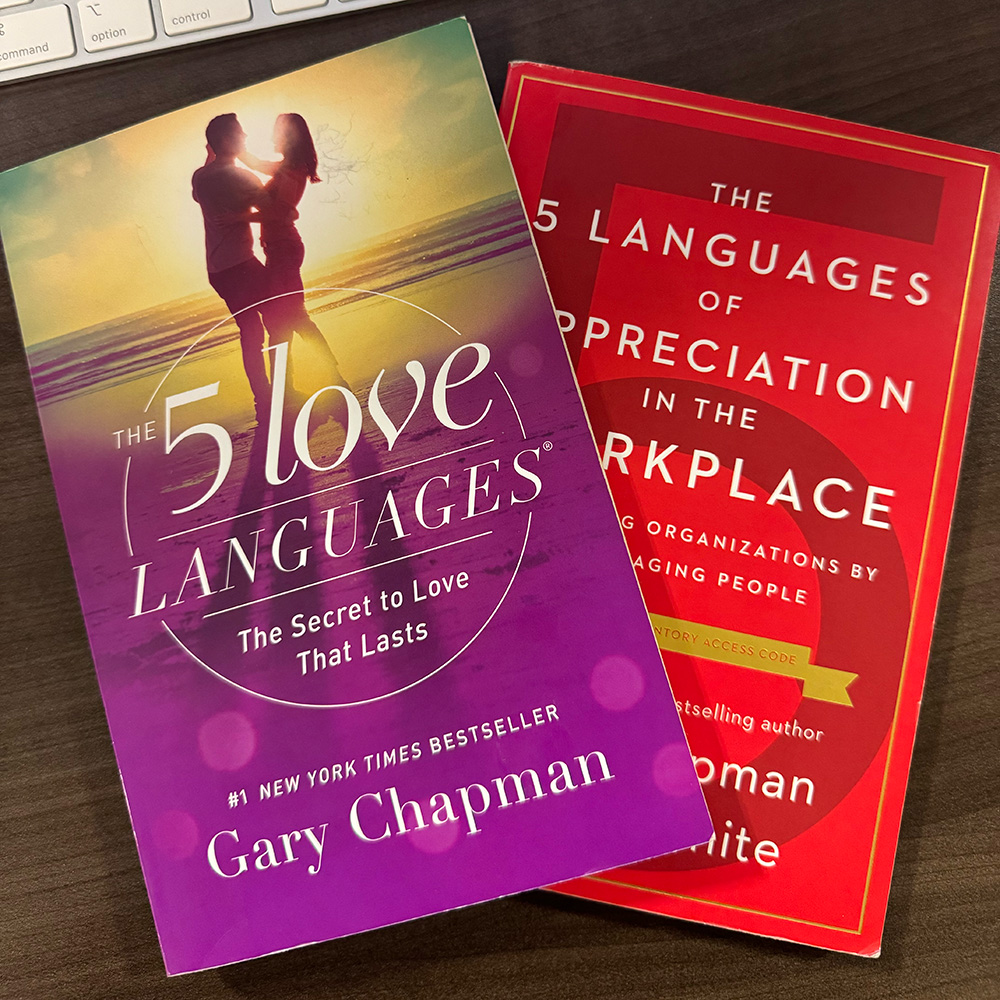
I’ve had the opportunity to lead several small groups and team meetings based on the ideas presented in 5 Love Languages and the workplace-centric version, 5 Languages of Appreciation. Understanding the needs and communication styles of those you’re around makes nearly everything easy, better, and more meaningful.
The Five Love Languages (5LL) by Dr. Gary Chapman was released in 1992. Chapman introduced the framework to help individuals express and receive love and appreciation in meaningful ways. Initially, 5LL focused on personal relationships. In 2011, Chapman worked with Paul White to apply these principles in the Workplace by releasing 5 Languages of Appreciation in the Workplace (5LA). While helpful in the Workplace, special considerations are needed.
In my experience, I’ve seen 5LL/5LA improve communication, strengthen relationships, and enhance trust.
What Are the 5 Love Languages
The 5 Love Langues are:
Receiving Gifts
Words of Affirmation
Quality Time
Physical Touch
Actions of Service
The acronym GATTS (Gifts, Affirmation, Time, Touch, Service) can be used as a reference.
Let’s talk about each in that order.
Receiving Gifts
People with this Love Language are often incredible gift-givers. For them, it’s not necessarily the magnitude or the frequency of a gift but the thoughtfulness of the gift. Chapman says, “Visual symbols of love are more important to some people than others” and that gifts can represent “A Reminder of Love.”
Examples
Bringing a coffee to a friend or colleague. Not just any coffee but THEIR coffee with the double shot, half-caf, oat milk medium in a large cup, double-sleeve coffee.
Celebrating wins and milestones with them. Is their thing Dungeons & Dragons or Xbox? How could that inform the token of your appreciation?
At work, it could include using Time Off as a gift – letting them come in late on a particular day, have a longer lunch, or leave early for a family event.
What’s their favorite movie, candy bar, or band… any of these (or thousands of other alternatives) could be used to celebrate and recognize them and their contributions.
Words of Affirmation
People who are built up by and encouraged with Words of Affirmation and respond to verbal or written expressions of praise and appreciation. Like gifts, these need to be genuine, authentic, and intentional. In order to speak this love language, sometimes the mantra “Words Are Important!” needs to always be on our mind or a post-it note on the mirror.
You might say, “But they should know… why should I have to keep telling them… I’ve told them before… just do your job…” As one who greatly values Words of Affirmation, I can tell you it’s much like a plant that withers as it lacks the water, sunlight, and oxygen it needs to live. Your decisions influence getting their best or a reserved (or injured) result.
When offering Words of Affirmation, Paul White adds, “…give words of affirmation that focus on the character of another individual. Character looks beyond performance and focuses on the inner nature of the person.”
Examples
Publicly recognizing their efforts during a meeting, group conversation, or in front of family members. Remember: You’re doing this for them – not for you to look or feel good. This is about speaking their love language. Check your motive.
A thoughtful and intentional email or text at the right time can mean more than you realize. (Pro Tip: Go next level and write them a handwritten note.)
Offer encouragement to them when it’s not going well when they are discouraged or down. Your words are powerful. Use your words to create life.
Thank someone for something they do routinely – something they may feel gets overlooked and/or underappreciated. Sometimes, receiving a compliment in an area where it’s unexpected can have the most value.
Quality Time
Quality Time emphasizes time – but time that isn’t distracted and purposeful to make someone feel valued. An often overlooked aspect of Quality Time is your ability to listen and be present. This could include meaningful conversations without your phone, looking them in the eye, and connecting with them. Sometimes, it’s sharing a space and reinforcing proximity (you’re not alone – I’m here with you).
If Quality Time is your love language – you know when it’s being met and when it’s not. It may look the same from the outside, but there is Quality Time, and then there is just time. If fairness, when the other person is missing on the “quality” aspect, you have to communicate this with them and not just expect them to “figure it out.”
Chapman provides this summary in identifying Quality Time: “The essential ingredients in a quality activity are: (1) at least one of you wants to do it, (2) the other is willing to do it, (3) both of you know why you are doing it – to express love by being together.”
Examples
Doing regular one-on-one meetings, allowing time for more meaningful interaction and discussion that talks about goals and feedback.
Listening attentively during the conversation – not rushing ahead, trying to get to the end, immediately jumping to “the fix,” and not getting distracted by your phone or projects. Maintain eye contact. Being intentional this way can help prevent your mind from wandering.
Creating space and time so they know they are heard and not alone. Rarely do they need you to fix the thing they are sharing with you – they are looking for a meaningful connection.
Make time every day to share some of the day’s events with each other. It seems simple and obvious, but how often does the news or social media get your attention before the person right in front of you?
Physical Touch (Adapted for Workplace Appropriateness)
Touch can communicate trust, caring, empathy, and connectedness.
In personal relationships, there are so many subtle ways to communicate love and appreciation through physical touch – holding hands, a hug, resting your hands on their shoulders, putting your hand on their arm as you reach around them to pick something up. All of these (and the accumulation of these small touches) can be very profound for those moved by physical touch.
In the office, what is appropriate is much different. Ultimately, it comes down to what they consider appropriate and welcome – not you. For you, a pat on the back is no big deal – to someone else who may be crossing a border, that is not acceptable.
Examples
Offering a handshake or fist bump to celebrate.
Giving a high-five or pat on the back in the moment of achievement.
Non-physical gestures, like a thumbs up, are a way to communicate encouragement.
Especially in the Workplace, touch can be controversial. The key is understanding what is appropriate, welcomed, and acceptable as defined by them, not you.
Acts of Service
This language places a priority on being helpful in practical ways of support, often to alleviate challenges for others. These are your “givers”. They seem to intuitively understand how to make your day better or more satisfying. They can also be quick to meet your needs and just as quick to neglect their own and can struggle with boundaries. Acts of Service is one of my key love languages. I can tell you all the great things about it, but I can also point out some real pitfalls associated with being so “others-centric.” Acts of Service does not mean that you’re a doormat or a people-pleaser or that you should abandon your boundaries. Remember that love is freely given. It’s not coerced or demanded. If it’s a forced act, it’s likely to be compliance rather than love/appreciation.
Sometimes, doing what we think needs to be done can cause more damage than help. The answer…ask? “What would be helpful to you?” “How would you like this task to be done?” “When would be the best time to help?”
Examples:
Helping out with a time-sensitive project.
Taking care of that chore or task around the house as a thoughtful expression of their appreciation for you.
Running “interference” for them so they can focus on the project, event, Super Bowl, movie, etc.
Finding small but significant ways to ease your stress.
“What’s my Love Language…”
Understanding your love language and learning those of your spouse, family, friends, and colleagues is incredibly valuable (more on this in a moment). So how do you determine your love language?
Reflection: Start with Self-reflection: Think about the times you’ve felt most valued and appreciated. What made you feel that way? Someone bought you a small gift they knew you’d like. Jump in to help with a project. These are good indicators to consider. We’ve often not spent the time thinking about it or putting language around it.
Observation: Secondly, take stock of the things you do to communicate your affection or appreciation to someone. Often, the way WE communicate love is a reflection of how we best FEEL love. “…of course, they’ll feel appreciated this way… I do when someone does that for me… how could they not feel appreciation from that?” This may not be perfect, but it can be a good indicator.
Assessment: Finally, you can do a free online assessment here or here.
Note: An assessment tool is available for the workplace/5 Languages of Appreciation, but it is a paid service. If interested, you can access it here (I do not receive any compensation or benefit from this – I’m only passing the link along to you for your review and consideration.)
Why Understanding the 5LL/5LA is Valuable
Ok, so you’re intrigued. The idea of communicating your affection and appreciation in a meaningful way to someone (that may be different than how you like to receive affection and appreciation) resonates with you… but does it really make a difference?
I could point to many examples of improved morale, increased production, and less turnover in the Workplace. At home or in your personal relationships, I could talk about improved communication, enhanced trust, and a deepened sense of empathy. All of which would be true.
That said, applying 5LL/5LA genuinely and authentically allows the other person to feel seen, heard, and understood. I’ve never been in a situation where, when someone felt more seen, heard, or understood, the situation and/or relationship weren’t substantially improved.
Warning
As French philosopher Voltaire (and Spiderman) said, “With great power comes great responsibility.” The 5LL/5LA is not a tool to use and get what you want. When misapplied or abused, they can cause irreparable damage. When abused or misused, the 5LL/5LA look like:
Receiving Gifts: Extravagant or impersonal gifts can make people feel uncomfortable or manipulated.
Words of Affirmation: Insincere or generic praise can feel empty and shallow.
Quality Time: Excessive demands on someone’s time may feel invasive and push them away or cause them to shut down.
Physical Touch: Unwelcomed or inappropriate touch can cross boundaries (personal and cultural) and cause discomfort or misinterpretation.
Actions of Service: Overextending yourself can lead to your burnout and/or their dependency.
Developing trust and maintaining awareness and sensitivity (aka “Read the Room”) is the key to using 5LL/5LA effectively. When in doubt, ask.
Now What
As I’ve talked with teams, small groups, friends, and family about the 5 Love Languages, it is always a valuable lens to learn about others and has created interesting and insightful conversations. The first step is to understand your love language and understand how to recognize preferences in others. Take the test and see what you learn.
|Character| Be more concerned with your character than your reputation, because your character is what you really are, while your reputation is merely what others think you are. John Wooden
I can think back to the times that I confused reputation for character. Words matter, especially when it comes to character.
It’s easy to focus on reputation – it’s how others see us. When we do well, and people appreciate us or the thing we did, that feels great. But reputation is just a shadow that is shaped by the light of our actions and words. It can shift with perspective and fade with time. Our reputation, hopefully, is a reflection of what is found in our character. Character is our unshakable core. It’s who we are – truly beyond the opinions and judgments of others.
When life goes sideways, the day is hard, the results aren’t good, the weight is heavy, our reputation is an insufficient refuge. But character is where we find strength and resilience. There is a word in the Greek language that I love – “Poiema,” which is where we derive our words “poem” and “poetry.” Beauty and artistry. Your character includes the beauty and artistry of integrity, authenticity, resilience, clarity, purpose… these are the steady ground on which you stand. Your character is forged and strengthened through hardships, integrity, and perseverance.
By prioritizing and investing in your character, you cultivate authenticity. Authenticity is a key ingredient in peace. Circumstances will test you. Others may disappoint you. But your character remains a sanctuary to find clarity and purpose.
What matters most is not the shadow that is cast, but the substance – the beauty and artistry within. Focus on who you are and how you act when no one is watching. Let the shadow take care of itself.
|Difference| Don’t aspire to make a living, aspire to make a difference. Denzel Washington
How is success best measured? The size of a paycheck? The new title? The brand you drive, wear, or carry? Have you ever stopped to wonder what people will remember about you—not for what you owned, but for what you gave to the world? We know that it’s none of these things, and what matters is the indelible mark we leave on others and the change we bring within our circle of influence. For sure, making a living is necessary, but real joy and satisfaction are found in using our work, time, and energy to create something meaningful. Something that can leave a legacy. Something that makes things better.
We all have a unique opportunity to contribute – to lift and encourage others, to solve problems, to bring your expertise and perspective to the discussion, and to pursue something greater than ourselves. To make a difference.
The beauty of making a difference is that it doesn’t require grand gestures. More often, you make a difference in the small, consistent actions you take, the way you make someone feel, reminding others (and ourselves) of how much we have to be grateful for. Gratitude is a powerful tool for making a difference, as it allows us to appreciate what we have and share that appreciation with others. Gratitude fuels generosity. When we understand and appreciate what we have, we instinctively share it—our time, kindness, and perspective—with others, creating ripples of encouragement.
When considering your next step – concerning the new job offer, how to proceed in the project, or the attitude you choose for the day – ask yourself: “How do I leave things better than I found them?” Acting on this answer can make a more significant difference in your life and the lives of others than you would probably guess.
So, don’t just aspire to make a living; aspire to live a life that leaves others richer in hope, joy, faith, and purpose. That’s the real difference you can make.
|Moments| If we take care of the moments, the years will take care of themselves. Maria Edgeworth
You are not defined by one moment – good or bad. Life…your character, is built on the consistent actions we take each day—consistency over time. Our habits, those seemingly insignificant choices (often that very few, if anyone else sees but you), lay the foundation for who we become.
James Clear, in his book Atomic Habits, brilliantly and succinctly puts it this way:
Every action you take is a vote for the type of person you wish to become. No single instance will transform your beliefs, but as the votes build up, so does the evidence of your new identity. This is one reason why meaningful change does not require radical change.
Small habits can make a meaningful difference by providing evidence of a new identity. And if a change is meaningful, it actually is big. That’s the paradox of making small improvements.
So, when we take care of the “little things” – the moments, we are set in a direction to improve and grow as needed. When we neglect the “little things” – the moments, we’re also set in a direction. However, it probably does not end up where or how we’d like.
Gratitude plays a pivotal role in our personal growth journey. When we shift our focus from what we lack to the blessings, abilities, and gifts we already possess, routine moments transform into instances of growth and fulfillment. Gratitude not only enhances our perspective but also makes it easier to embrace healthy habits and sustain them.
By consistently showing up for the “little things,” coupled with gratitude, we shape tomorrow one day at a time. Trust the small, intentional actions and see how they lead you to grow. A successful life isn’t dependent on big breakthroughs. It’s about embracing today’s opportunities by showing up to grow, learn, and connect. Tending to the “little things” is key to leading us to a life with meaning and purpose.
Encouragement can make the difference between a good day and a bad one. It’s the ingredient that, for some reason, we can be stingy about sharing. Encouragement can speak life into someone, helping them pick themselves up and keep moving forward, even when (or maybe especially when) they didn’t believe they could continue, let alone make it through.
Encouragement, in all its various forms, can foster deep relationships and has a broader ripple effect than you might imagine.
Encourage/Being an encourager/Encouragement is why I create this content. For some, it’s an easy thing to do. For others, it takes a more intentional decision. Not because they don’t want to encourage others or they don’t think it’s important, but because it just doesn’t flow naturally.
Here are some thoughts on intentionally encouraging and building stronger connections where you have influence.
Superpowers
You may have a person or two in your life who are not just encouragers but Super Encouragers (go ahead and imagine them with a cape and a superhero utility belt). It’s just who they are. What is it about them that makes them such a great encourager? My guess is that they share some of these Superpowers:
Active Listener: One of the primary tools of an encourager is active listening. They pay attention to what you’re talking about and saying. They listen for cues where you may need support or reassurance. They listen to and remember your story, problem, or preference. Then, they ask about your story. They follow up on how you’re doing with that problem. They circle back to that area where you needed support – sometimes days or weeks later. And you’re struck with, “Wow! They really listened to what me.” Active listening shows them (and you) that they care and helps them understand how to encourage you most effectively.
Genuine and Authentic: The next tool in the tool belt for these Super Encouragers is being authentic – being real. You don’t get the sense that they are trying to manipulate you. They are genuinely interested in you. If they aren’t genuine and authentic, you can sense it – it comes off as forced or insincere as if there is an Encouragement Quota they need to satisfy. Instead, they take the time to understand what you need and try to deliver it.
Positive Language: This may seem obvious, but when these Super Encouragers are at their best, their language is… wait for it… encouraging, positive, and helpful. Why is this a big deal? Often, the time that we need the most encouragement is when all the language that is rolling around in our brains – isn’t encouraging, positive, or helpful. We speak to ourselves in ways we would never talk to a friend or colleague. Yet, because it’s in our heads – somehow, it’s “normal.” The Super Encourager believes in you when you’re struggling.
Celebrate Effort, Not Just Results: Finally, the Super Encouraging understands this is a journey. That this moment, event, or season isn’t the end all, but rather, progress. They acknowledge the hard work you put into a task, regardless of the outcome. Does that sound too “soft”? If you’ve ever been around a baby – everything is progress. The first time they turn over, sleep through the night, the first time they walk. There aren’t a lot of people out there who, looking at the baby, who tried to take a step and fell, would berate the child, “…look at you – you can’t even walk…” It might be a silly comparison, but the fact is, they are on a journey, and they are making progress. So are you. The Super Encourager often reminds you of this and celebrates the wins along the way… and the results when you get there.
Here’s the great thing about these Superpowers – they’re totally learnable. They don’t require that you get bit by a radio-active Encouragement spider or be ejected from your Super Encourager planet, only to realize your natural skills are on hyper-drive once you hit the earth’s atmosphere and (…too much with the Superhero analogy… got it). You can learn, enhance, and grow these skills.
Superpowers: Activate
So, what does this look like in real life? Here are a few simple examples:
At Work: You notice that someone is struggling with a presentation. Instead of criticizing or ignoring it, you offer encouragement by pointing out that they’ve got some great ideas and offer suggestions on how to present them. You offer to help them practice the presentation. This act of encouragement can help provide the confidence they need, resulting in a better presentation and a new level of connection.
With A Friend: You’ve got a friend who’s going through it. You offer to buy them coffee and listen to their story. The simple act of being present, genuine, and listening can speak volumes, reminding them that they’re not alone and that you’ll walk through it with them. Knowing you’re not alone is a huge encouragement.
As A Parent: With kids, the list of situations they run up against where they can feel defeated is nearly limitless. The list goes on: a grade, a performance in a play, a game, a relationship. As a parent or adult who has influence in their life, you have a unique opportunity and ability to speak life into them. Simple words like, “I’m so proud of you and how hard you work. It may not feel like it now, but it will get better, and I’m here with you.” Not only can this help in the moment, but you’re also developing resilience and a growth mindset.
Secret Identity
Encouraging others not only benefits others but also encourages you. You’re serving others. You’re being empathetic. You’re listening. You may be providing some amount of healing. You’re able to conceptualize and see beyond the present to envision what might be. You can draw from your past experiences and present realities to help guide them. You’re helping them grow. You’re developing community. If that list sounds familiar – it’s because those are all traits associated with Servant Leadership.
“When we encourage others, we boost their self-esteem, enhance their self-confidence, make them work harder, lift their spirits, and help them achieve their goals. Encouragement goes straight to the heart and is always available. Be an encourager. Always.” — Roy T. Bennett
Why it Matters
Encouragement can be the difference between giving up and powering through – even if just barely. It reminds others that someone believes in them, even when they doubt themselves. When you encourage others, you help them grow and fortify your relationship with them by increasing trust and respect. Encouragement creates an environment where people feel safe to take risks, learn, and thrive.
“A word of encouragement during a failure is worth more than an hour of praise after success.” — Unknown
|Love Means| To love means loving the unlovable. To forgive means pardoning the unpardonable. Faith means believing the unbelievable. Hope means hoping when everything seems hopeless. Gilbert K. Chesterton
We want love. We need love, but it can be hard. We want forgiveness, we need forgiveness, and then we find it can be hard to extend forgiveness. We want faith. We need faith, and then life gives us a situation that drains our faith. We want hope. We need hope. Then, life is hard, and it isn’t easy to find hope.
These virtues are not those of convenience. These are the building blocks, the DNA that we need to live. Often, they are easy to receive. They are gifts, but they are gifts that are forged and fortified as a result of trials. Frequently, they are hard to extend…
When he walks out… She wants forgiveness… You’ve believed and believed and believed… and still nothing… You want to hope, but it seems too grand, too far away.
But moments like these allow us to see the true depths of what love looks like and what it will do. We experience what forgiveness looks like and how far it will go. We get a glimpse of what faith can reveal and the heights it will reach for. We realize what hope is willing to endure and the length of time it will hold out.
When life is hard and overwhelming, it’s easy to believe these are out of reach. However, it’s in these exact moments that the extraordinary (miraculous?) becomes possible.
Love grows most powerfully when it’s unconditional. Forgiveness is most freeing when the burden is too heavy or not ours to carry. Faith deepens when it sees us through to the other side. Hope is most encouraging when it’s the light in the darkest moments.
Gratitude is the catalyst that allows the virtues of love, forgiveness, faith, and hope to grow. That helps us to grow. Gratitude helps us see beauty, even in brokenness. It reveals how challenges shape us to help us grow in strength, resilience, and compassion.
As we shift our focus to view challenges not as obstacles but as opportunities to deepen our faith, broaden our scope of forgiveness, inspire others with our hope, and grow in love, our perspectives change. As we’re able to keep going, we realize that this is something to be grateful for.
Three things will last forever—faith, hope, and love—and the greatest of these is love.
|Brand New Ending| Though no one can go back and make a brand new start, anyone can start from now and make a brand new ending. Carl Bard
It’s a new day. It’s filled with new opportunities. There’s new mercy. Grace is abundant, and gratitude is a choice available to you. Yesterday is just that… yesterday. You can’t change it or rewrite it. But we do have the capacity to shape what lies ahead. This moment – right now- provides the opportunity to grow, to learn, to encourage, and to move forward with purpose and optimism. But it is a choice to be made.
Too often, we can get stuck in a “should’a/could’a/would’a” mindset, which can cause regret and doubt and cloud our perspective. Instead of focusing on what was, we can shift our focus to what is in front of us. Each step forward is progress, no matter how small or seemingly insignificant.
Gratitude is foundational to this shift. By spending more time recognizing the blessings we have, we cultivate a perspective of possibility and optimism. I’m going to go out on a “statistical branch” here… If you’re reading this, you’ve successfully made it through 100% of the challenges you’ve faced so far. Congratulations! Each challenge has taught you resilience – and probably more. Each success, no matter how small, has brought you to this place – to this moment.
Keep going. Look forward. The beauty of this life is that it’s never too late to begin again. You can write a brand new ending today.
|Reflect| Reflect upon your present blessings of which every man has many – not on your past misfortunes, of which all men have some. Charles Dickens
Don’t get stuck thinking, “…this is the best it will be.” Don’t get stuck on that setback, that breakup, that opportunity you missed, that hardship. Instead, make the choice to shift your focus to the blessings and beauty that are in front of you right now. You have more than you think.
Plan ahead – when negative thoughts or the focus on “the misfortunes” presents itself, what do you want to replace that thought with? A good memory? A scripture or prayer? A relationship?
Wrap all of this in gratitude. Gratitude sustains us and can be the fuel that encourages us to keep going. My intent is not to make light of or dismiss hardships. We’ve all experienced them. Some are tragic. Others are heartbreaking. Some… seem to go on without end. I also know that we’ve experienced great blessings that we (I) can often overlook or take for granted. Gratitude sets our gaze beyond this moment.
Slow down today. Take a moment. Enjoy and appreciate the many ways you’ve been blessed. Don’t overlook the simple things: the place you get to call home, hearing someone special laughing in the other room, or a quiet night. Where do you find love, joy, peace, kindness, goodness, and faithfulness? Set your mind on these things.
Broaden your perspective. When we limit our perspectives to a myopic focus, we miss the beauty of the masterpiece that is our life.
|Hope| Hope transforms every trial. |Kris Langham|
You’ve probably seen the post or the sweatshirt that says, “Everyone is fighting a battle you know nothing about. Be Kind.” I like that. It creates space for grace and empathy. However, it’s lacking… it’s the silence at the end that is deafening – especially if you’re the one fighting the battle.
If the statement ends there, there is someone just going through it, doing their best – sometimes just fighting to keep their head above water. Maybe it’s you? You’re fighting the battle. Doing your best, but it’s taking its toll. It’s causing you to be less patient than usual. Your short response brings a retaliatory reaction from the barista, the guy driving slow in the fast lane, “…if they only knew what I was going through…”
What if they did know what you’re going through? What would you want from them? Help? Sure. We’ve all had that friend, family member, and sometimes even a stranger who steps in to offer a helping hand to help lift the load, watch the kids, or run interference for you. It’s great, but likely, something more got you to that point that is still unresolved. Maybe that helping hand was just enough help for you to get your feet under you and keep going. Excellent. But often, there is still an ache, a gap that needs to be filled.
Hope is often the real missing ingredient. The storm is raging. The night is dark, “… here’s an umbrella…” Thanks – but the storm is still there, and the night is still dark. But instead of an umbrella, what if there was the promise of warm shelter just around the bend, and there is a trustworthy guide to lead you there? Hope. Suddenly, you muster the strength to dig deep and take the final steps to get you to the sanctuary. The storm is still there. The night is still as dark, but suddenly, there is hope.
Trials seem to come at a constant rate. I have them. The people in the circles around me have them. A friend remembers his wife passing from cancer 10 years ago. A buddy wrestles with the weight and evil he sees daily as a detective. Another is looking for work.
My word for you…for them…for me: Hope. It’s there – I promise. If you’re having a hard time finding it, ask that friend or family member to help you find it. It’s there. Perhaps you’re in a place where you can be the one to offer hope. You can be the guide who knows about the shelter.
There is hope. Set your mind to find it.
Offer hope. Be intentional about sharing it with those around you.
When the storm calms, and it will… When the dawn breaks through, and it will… be grateful. Gratitude is good for the soul.







 Be encouraged