
When “leadership” is mentioned, many ideas can come to mind. Vision. Decisiveness. Strength. Strategic. Competitive. All of these may be accurate. Many are desirable, but some, depending on how they are portrayed, may not.
Two ideas have influenced my perspective on leadership. The first came from my business coach, who said, “The accumulation of little things is often more impactful than the one ‘big thing.'” The second is a succinct quote from John Maxwell: “Leadership is Influence.” These quotes added nuance to my experiences with the leaders in my life—both good and not-so-good. They have also led me to the ideology and approach to leadership called Servant Leadership.
Servant Leadership

Robert K. Greenleaf formalized the idea of Servant Leadership in a series of essays. The term Servant Leader was introduced in an essay called The Servant as Leader, published in 1970. From the first time I read about it, the approach of Servant Leadership resonated with me. It aligned with my values and my view of people.
Greenleaf’s ideas were, in part, inspired by Hermann Hesse’s novel The Journey to the East (1957). In Hesse’s story, the character Leo embodies servant leadership. He starts as a servant to a group of travelers. (Warning: Spoiler Alert!) Later, it’s revealed that Leo is the spiritual leader of a secretive group called the League. The parable teaches that leadership isn’t about title or role; it’s about serving and uplifting others.
Applying Servant Leadership.
In his essay, Greenleaf has a line that resonates with me and, in my opinion, is the litmus test of being a leader:
Do those served grow as persons? Do they become healthier, wiser, freer, more autonomous, and more likely themselves to become servants?
My influence… my leadership, can be revealed in those around me. I care, support, serve, and influence them. I often miss the mark, but this is what I aspire to.
The Traits of a Servant Leadership

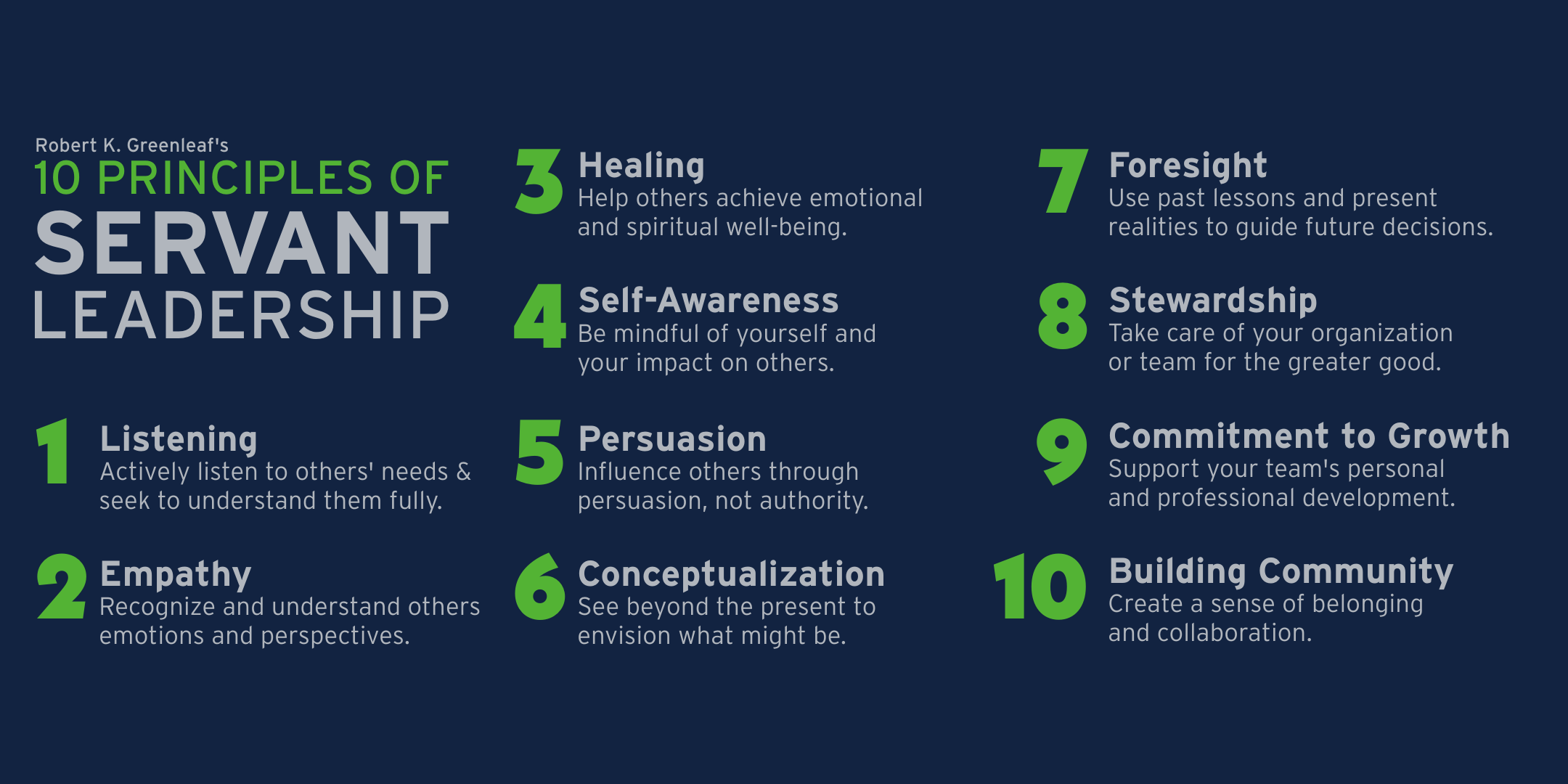
Greenleaf outlined ten traits of servant leaders:
- Listening: Actively listen to others’ needs and seek to understand them fully. Often, this requires that we listen more than we talk. Consider more than we persuade. This leads nicely to the next trait…
- Empathy: Recognize and understand others’ emotions and perspectives. Alfred Adler described empathy as “Seeing with the eyes of another, listening with the ears of another, and feeling with the heart of another.”
- Healing: Help others achieve emotional and spiritual wellbeing. This idea might lead you to the thought, “… but that’s…*EMOTIONAL*… this is work! Can’t we just avoid emotions and do work…” I’ll let you decide if those things can be separated.
- Self-Awareness: Be mindful of yourself and your impact on others.
- Persuasion: Influence through persuasion, not authority.
- Conceptualization: See beyond the present to envision what might be. Another way to think of this is “looking forward.”
- Foresight: Use past lessons and present realities to guide future decisions. Another way to think of this is “looking back.”
- Stewardship: Take care of the organization or the team for the greater good.
- Commitment to the Growth of People: Support your Organization’s/Team’s personal and professional development.
- Building Community: Create a sense of belonging and collaboration. We were made for community.
I’ve seen and read an additional trait that other students of servant leadership have added:
Bonus: Calling: You are the right person, at the right time, for the right reason. You may not feel like a “leader” or even want to be one. But for whatever reason, you are in the position you are, with the influence you have for a reason. Embrace it.
Leadership is not always “the one big thing.” Very often, it presents itself in the collection of small things done well and consistently.
In his book Atomic Habits, James Clear said,
“Every action you take is a vote for the type of person you wish to become. No single instance will transform your beliefs, but as the votes build up, so does the evidence of your new identity.”
This applies to becoming the leader you want to be and that those around you want you to be.
Myths of Servant Leadership

As I’ve studied servant leadership, I have seen opponents to the idea because it’s so contrary to “traditional leadership.” A few examples include:
Servant Leadership is just “easy” or “being everyone’s friend.” I can appreciate the thought process to get there when I hear this, but I disagree with the conclusion. A quote I recently read provided a great response. In his book Know What Matters, Ron Shaich says,
“Servant leadership isn’t about being nice at all costs. It’s about being helpful at all costs. And radical honesty is a much greater service to people than simply being kind.”
Servant Leadership is just a “Christian/religious thing.” Without a doubt, there is a spiritual quality to servant leadership. Many people will point to Jesus’s quote, “Jesus called them together and said, “You know that the rulers of the Gentiles lord it over them, and their high officials exercise authority over them. Not so with you. Instead, whoever wants to become great among you must be your servant, and whoever wants to be first must be your slave— just as the Son of Man did not come to be served, but to serve, and to give his life as a ransom for many.” Matthew 20:25-28
Servant Leadership is seen in quotes from teachers of many faiths:
- Mahatma Gandhi: “The best way to find yourself is to lose yourself in the service of others.”
- Dalai Lama: “Our prime purpose in this life is to help others. And if you can’t help them, at least don’t hurt them.”
- Thich Nhat Hanh: “The practice of compassion and loving-kindness is not about being nice but about being real and truthful, helping others to transform their suffering.”
- Prophet Muhammad: “The leader of a people is their servant.”
- Guru Nanak: “The essence of life is to serve others and do good.”
Servant Leadership Sacrifices Results for Relationships: Simply because you focus on people and their well-being and growth doesn’t mean you ignore outcomes. My experience is that when you focus on people, you have better outcomes, able to stand to adversity and challenges, and can do it faster (Ref. Steven Covey, The Speed of Trust)
Alternatively

When creating training content on servant leadership, I got a weekly email from Inc. magazine. The email provided a link to an article called “5 Signs That Instantly Identify Someone With Bad Leadership Skills. The list included:
- Narcissistic Tendencies
- Not recognizing their people for good work.
- Treat people like numbers
- Too much control
- Not sharing information
I found this list and these traits interesting compared to the material I was preparing. When servant leadership is demonstrated well, people are drawn in and thrive.
Your Influence Matters

I believe we’re all here for a reason. I believe you’re in the situation you’re in—good or bad, challenging or encouraging—for a reason. You have the opportunity to learn. You have the opportunity to serve. It’s about choosing to do the small things that build trust, inspire others, encourage others, and foster gratitude in others and yourself. By focusing on the well-being and development of others, we can make a lasting impact—not just as leaders but as human beings. One last quote to drive this point home, Donald McGannon says,
Leadership is an action, not a position.
Lead with intention, serve with humility, and influence with purpose.
Be Encouraged. Be an Encourager.
If you’re interested, here is a version of the slide deck I’ve used to present the ideas of servant leadership.
Servant Leadership Slide Deck
Servant Leadership Traits – Desktop Reminder. I have this sitting on my desk at all times.
 Be encouraged