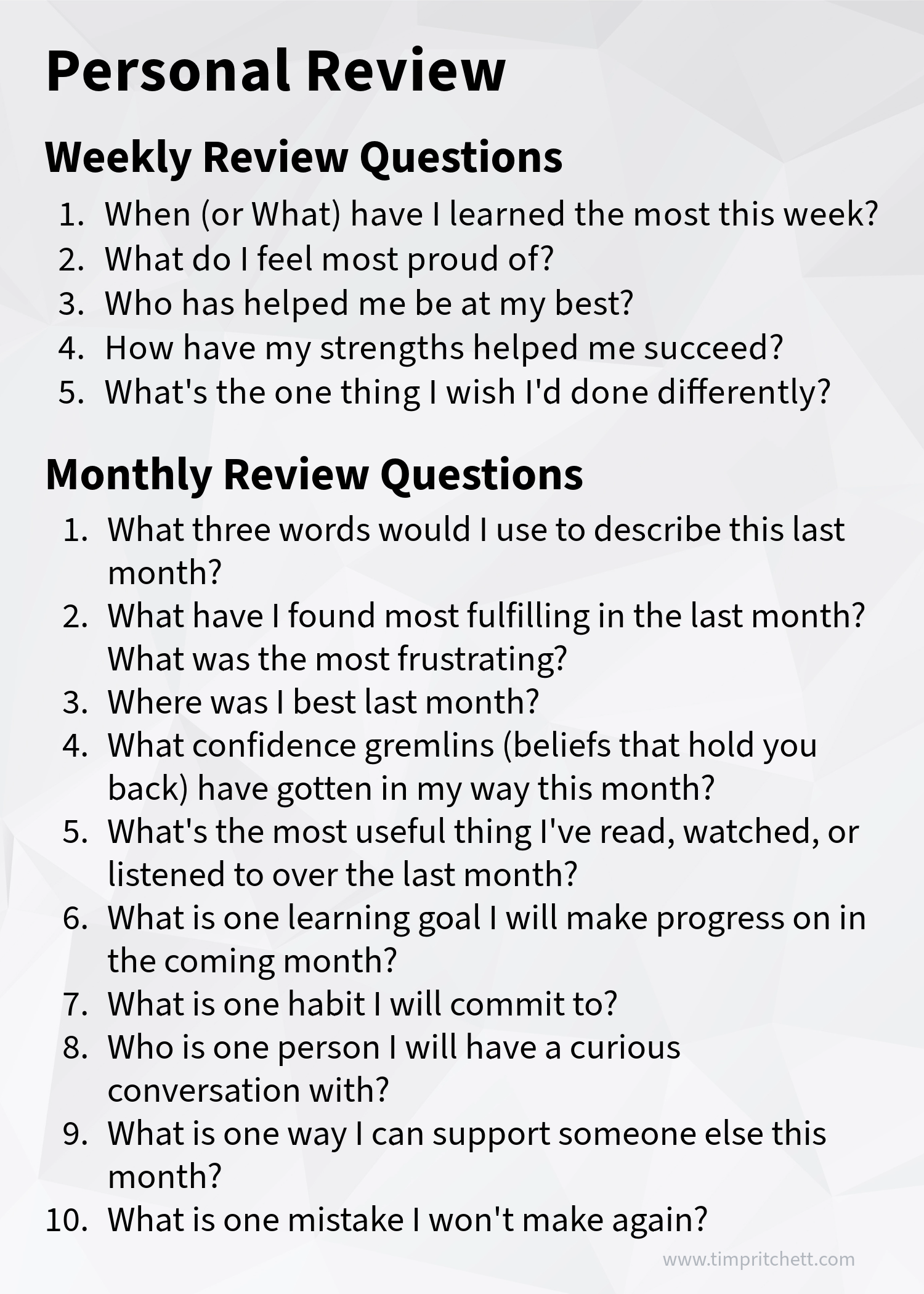

Self-reflection is an essential ingredient for personal and professional growth. Making the intentional decision to slow down… quiet down, and consider your circumstances, the things you’ve learned, and what and how you want things to be different can reveal more than you imagine. I have a series of questions I use that I found in an HBR article entitled, not surprisingly, “How to Create Your Own ‘Year in Review.'” I’ve modified how I use the questions and customized them for my conversations.
I use five questions for a weekly review and 10 additional questions for a monthly review. To help keep me aware (and to supplement my flagging memory), I keep a list of “Week in Review” comments in my journal of noteworthy events, outcomes, changes, etc. These journal entries help inform my weekly review. The weekly review helps inform the monthly review. Each piece stacks on the next. I’ve also used some of these questions in 1:1 meetings with people and received some insightful results.
As with anything, honesty is the key to the effectiveness of these questions and this exercise. Don’t give answers that make you feel good or skirt around an area that needs attention. Acknowledge it, own it, and work on it.
Also, sometimes, to get real answers, bring in someone you trust. Someone who will speak the truth in love, someone who can point out your blind spots, and someone who wants to see and help you grow and improve.
Feel free to download and use this framework as it is or adapt it to suit your needs. Ready? Ok – let’s go.
Weekly Review Questions:

- WQ1: When (or What) have I learned the most this week?
- Book looking for the lessons you’ve encountered and how that can shape how you act.
- WQ2: What do I feel most proud of?
- You do more good than you realize. Also, developing the muscle to be encouraged in (and by) yourself is valuable. The world can get loud at telling you you don’t measure up. How do you respond?
- WQ3: Who has helped me be at my best?
- Someone, somehow, somewhere, helped you this week. Who was that? How can you express appreciation for their contribution?
- WQ4: How have my strengths helped me succeed?
- This question helps you focus on two things – your strengths and your successes. You need to be prepared – even if just for yourself – to know what and how to articulate both.
- WQ5: What’s the one thing I wish I’d done differently?
- Thinking through these better equip you the next time you encounter a similar situation. Without any reflection, the same instinct will probably lead to your reaction again. Stephen Covey is famous for pointing out the idea of a moment between a “stimulus and a response,” where a person can choose how they respond.
- Is that speaking up? Staying quiet? Putting in the work to be prepared? Dedicating the time to rest?
Monthly Review/1:1 Questions

- MQ1: What three words would I use to describe this last month?
- Start with a high-level summary. Over time, it’s interesting to see how these words can change.
- The answers to your weekly in-review questions and notes help you distinguish between the month and this moment. The month may have been great, but this moment may be a train wreck. Avoid the temptation to confuse a moment with a period of time.
- This helps increase and broaden your perspective and helps to set the stage for the following questions.
- MQ2: What have I found most fulfilling in the last month? What was the most frustrating?
- Understanding what brought you joy and what caused stress can help you determine where your energy is being spent, what things you should double down on, and what areas need adjustment.
- MQ3: Where was I best last month?
- Recall when everything aligned for you – your work, values, energy, and skills. What were you working on? What contributed to the value of this moment and the fulfillment you experienced?
- MQ4: What confidence gremlins (beliefs that hold you back) have gotten in my way this month?
- Often, this is one of the most valuable questions for me. I continue to quiet the internal monologue and narrative of how I’m doing, my weaknesses, etc. I marvel at the people who say they don’t have that voice going off in their heads.
- Understanding limiting beliefs is the first step to overcoming them. Additionally, understanding if my thinking is real or true is essential. My imagination can be, unfortunately, creative at times.
- When did self-doubt start to creep in? Why?
- How did these thoughts impact my decisions or actions?
- MQ5: What’s the most useful thing I’ve read, watched, or listened to over the last month?
- What are you learning, and where are you learning? A book? Podcast? Class? A conversation?
- What is impacting your thinking and actions?
- Why did this resonate with you? How did it influence you? How can it influence others? Who else will this resonate with?
- MQ6: What is one learning goal I will make progress on in the coming month?
- What topic, tool, or skill do you want to improve on? Do you want to figure out Pivot Tables in Excel? Learn to play guitar? The good news is that there are a ton of resources and people who can help you in these areas.
- Create a specific and actionable goal to increase your understanding or skill.
- Be clear about what success would look like and feel like for you.
- Celebrate even the small wins you go through on this journey.
- MQ7: What is one habit I will commit to?
- What is one habit that aligns with your values or goals? A new morning routine that includes journaling? Committing to regular exercise?
- I like this quote from James Clear:
Every action you take is a vote for the type of person you wish to become. No single instance will transform your beliefs, but as the votes build up, so does the evidence of your new identity. This is one reason why meaningful change does not require radical change.
Small habits can make a meaningful difference by providing evidence of a new identity. And if a change is meaningful, it actually is big. That’s the paradox of making small improvements.
- MQ8: Who is one person I will have a curious conversation with?
- The original context of this question was related to a career conversation – Who has insight, experience, or expertise that you admire? For the price of a cup of coffee, you can enter into an amazing conversation and (re)establish a relationship.
- I like this because it also motivates me, especially when I need to talk to someone I may not want to because the conversation is hard or I need to seek forgiveness and/or repair a relationship that has been damaged. This can push me out of my comfort zone.
- Either way, be specific about your intention.
- MQ9: What is one way I can support someone else this month?
- How can you help someone else’s growth or success? Offer to be a mentor? Share resources? Be a good listener? You have more to offer than you probably realize.
- MQ10: What is one mistake I won’t make again?
- “I’ll never do that again.” Great! What is that?
- Mistakes are great opportunities to learn. Take advantage of that opportunity and that lesson.
- What will you do differently next time you encounter a similar situation?
I’ve found a regular review like this tremendously valuable. It’s not just about looking back. Instead, it’s about using reflections and the insights discovered to help move you forward with purpose. Considering questions like these honestly and thoughtfully creates a roadmap for continuous improvement and intentionality in your actions.
Be Encouraged.
 Be encouraged